
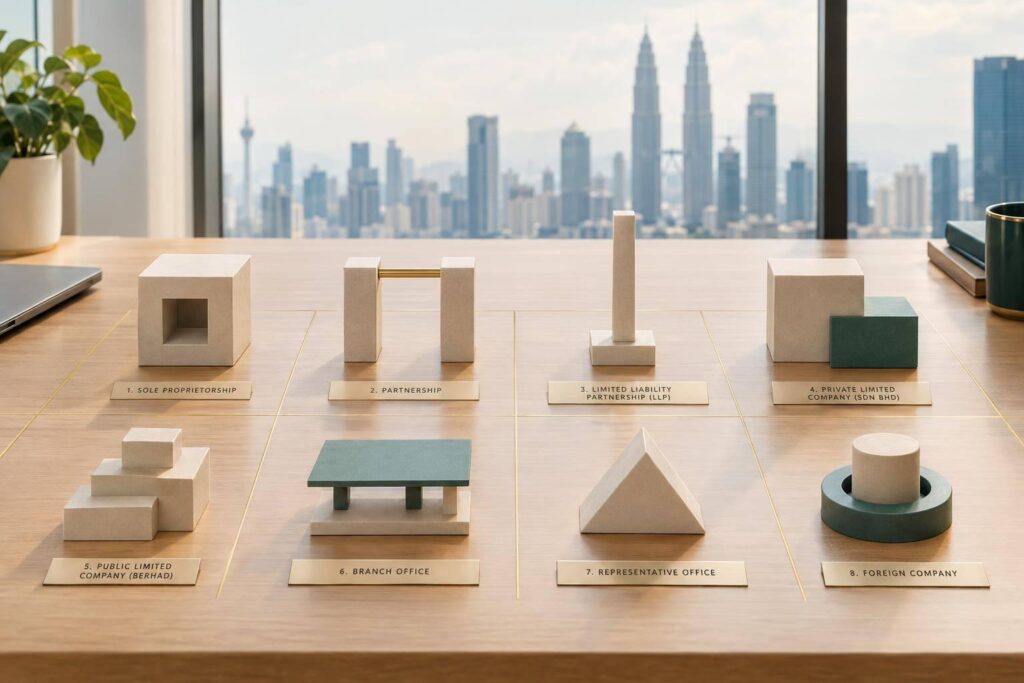

Choosing a business structure? I’d start with your personal liability, ownership plans and compliance costs – not just registration fees. This guide compares eight options, but <u>Labuan limited partnerships are not registered with SSM</u>.
For a small owner-run business, consider a sole proprietorship. For limited liability, compare an LLP, Sdn. Bhd. and sole proprietorship Public companies, non-profit bodies and overseas branches have different rules.
Quick Comparison
| Structure | Ownership | Liability | Common use |
|---|---|---|---|
| Sole proprietorship | 1 owner | Unlimited personal liability | Small owner-run business |
| Partnership | Usually 2–20 partners | Unlimited personal liability | Co-owned business |
| LLP / PLT | At least 2 partners | Limited, except for a partner’s own wrongful acts | Professional firms and multi-founder businesses |
| Sdn. Bhd. | 1–50 shareholders | Generally limited to unpaid amounts on shares | Privately owned SMEs |
| Berhad / Bhd. | No shareholder limit | Generally limited to unpaid amounts on shares | Public funding or a broad shareholder base |
| Company limited by guarantee | Members, not shareholders | Limited to the promised guarantee | Non-profit activities |
| Foreign company branch | Owned by the overseas company | Overseas company bears branch debts | Malaysian presence for an overseas company |
| Labuan limited partnership | At least 1 general and 1 limited partner | Unlimited for general partners; limited for limited partners | Investments and joint ventures |
Registration location matters too. Sole proprietorships and partnerships in Sabah and Sarawak follow local registration rules rather than SSM’s business registration framework.
Before you apply, I’d confirm the regulator, tax duties and filing requirements for your chosen structure.
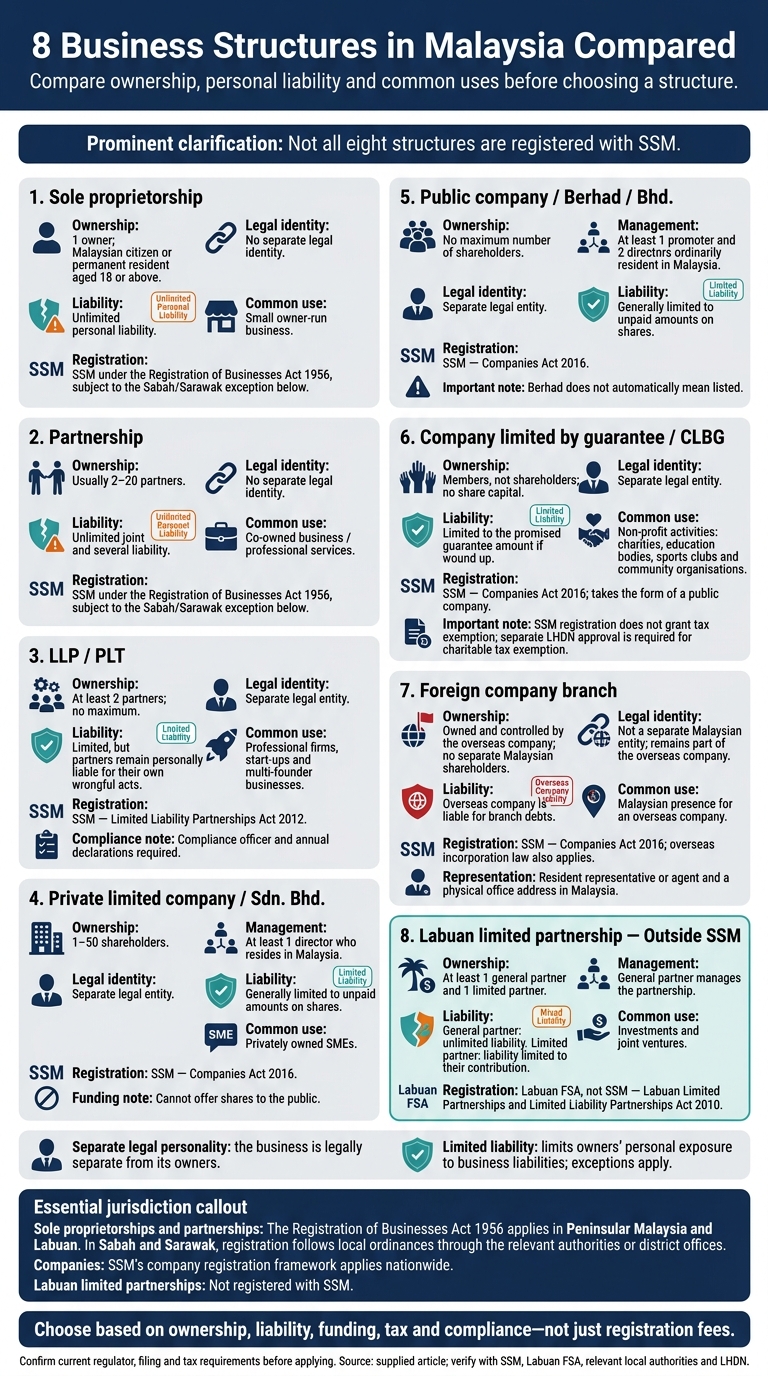
8 Business Structures in Malaysia Compared
PLT vs SDN BHD in Malaysia
sbb-itb-ba278e7
SSM and Business Registration in Malaysia
Suruhanjaya Syarikat Malaysia (SSM) registers sole proprietorships and partnerships under the Registration of Businesses Act 1956, LLPs under the Limited Liability Partnerships Act 2012, and companies under the Companies Act 2016. These laws set the SSM compliance requirements and governance rules for the entity types below.
Where you register matters for sole proprietorships and partnerships. The Registration of Businesses Act 1956 applies in Peninsular Malaysia and Labuan. In Sabah and Sarawak, these businesses register under local ordinances through the relevant authorities or district offices. SSM’s company registration framework applies nationwide. This framework includes the mandatory appointment and duties of a company secretary to ensure ongoing regulatory adherence.
Separate legal personality means a business is legally separate from its owners. Companies and LLPs can own assets and owe debts in their own name. Sole proprietorships and partnerships have no separate legal personality, so their owners can be personally responsible for business debts.
Limited liability is a different concept: it limits owners’ personal exposure to business liabilities. For a company limited by shares, shareholders’ liability is generally limited to unpaid share capital. This distinction helps explain the differences in ownership, liability and compliance across the eight entity types below.
Before registering, check the latest requirements. For a sole proprietorship or partnership in Sabah or Sarawak, confirm the requirements with the relevant local authority.
1. Sole Proprietorship
A sole proprietorship is the simplest business structure.
Legal framework and separate legal status
A sole proprietorship has no separate legal identity. In law, the business and its owner are the same.
Ownership and management requirements
There is one owner, who must be a Malaysian citizen or permanent resident aged 18 or above. You can register under your NRIC name or an approved trade name. Before registering a trade name, check its availability on the SSM portal.
Personal liability exposure
The owner has unlimited personal liability, which means personal assets are at risk if the business owes money. It’s the simplest option for a one-person business, but the owner bears the full risk.
Use cases and tax obligations
This structure suits small, owner-run businesses with simple operations. Sole proprietors must register with SSM. Business profits are taxed as the owner’s personal income, and the owner files personal income tax with LHDN.
If the business has two or more owners, a partnership is the next common structure.
2. Partnership
Legal framework and separate legal status
A partnership is a business owned and run by two or more partners who share profits and responsibilities. It has no separate legal identity, which means partners are personally responsible for the business’s obligations.
Ownership and management requirements
A partnership usually has two to 20 partners. A written partnership agreement should set out each partner’s contributions, how decisions are made and the terms for leaving the business.
Personal liability exposure
Partners have unlimited personal liability. One partner’s actions can bind the others, leaving them liable too.
Typical use cases and compliance obligations
Register the partnership with SSM and obtain a TIN from LHDN. If the business hires staff, it must comply with EPF, SOCSO, EIS and MTD/PCB requirements. HRDF may also apply.
For owners who want limited liability without setting up a company, the next option is an LLP.
3. Limited Liability Partnership (LLP / PLT)
An LLP lets business owners share control while limiting their personal liability.
Legal framework and separate legal status
In Malaysia, an LLP is registered as a PLT. It is a separate legal entity, distinct from its partners.
Ownership and management requirements
An LLP requires at least two partners. It suits co-owners who want to manage the business together while limiting their personal exposure.
Personal liability exposure
Partners have limited liability for business debts, helping to protect their personal assets.
Typical use cases and compliance obligations
LLPs suit professional practices, startups and multi-founder businesses. They must appoint a compliance officer and file annual declarations with SSM.
For businesses that need a more formal company structure, the next option is a private limited company.
4. Private Limited Company (Sdn. Bhd.)
A Sdn. Bhd. is the usual next step for businesses that want share-based ownership and limited liability.
Legal framework and separate legal status
A Sdn. Bhd. is a private company incorporated under Malaysia’s Companies Act 2016. It has separate legal status, with ownership divided into shares.
Ownership and management requirements
A Sdn. Bhd. can have up to 50 shareholders and must have at least one director who resides in Malaysia. Directors must be natural persons aged 18 or above, of sound mind and not disqualified under the Act.
As a private company, it cannot offer shares to the public.
Personal liability exposure
Shareholders’ liability is generally limited to any unpaid amount on their shares.
Typical use cases and compliance obligations
This structure suits SMEs that want share-based ownership and limited liability.
5. Public Company (Berhad / Bhd.)
A Berhad is a public company structure used when ownership needs to extend beyond a private group.
Legal framework and separate legal status
A public company limited by shares falls under the Companies Act 2016 and must use Berhad or Bhd. in its name.
Berhad does not automatically mean listed. Listed companies trade on a stock exchange; unlisted public companies do not.
Ownership and management requirements
A Berhad needs at least one promoter and two directors ordinarily resident in Malaysia. There is no maximum number of shareholders.
Personal liability exposure
Shareholders are liable only for any unpaid amount on their shares.
Typical use cases and compliance obligations
This structure suits public fundraising or a broad shareholder base. Berhad companies must undergo audits and meet stricter governance and reporting requirements.
If the aim is not to distribute profits, the next structure is a company limited by guarantee.
6. Company Limited by Guarantee
A company limited by guarantee (CLBG) is a structure for non-profit activities, rather than a profit-driven business.
Legal framework and governance
A CLBG is a separate legal entity set up for non-profit purposes. It may apply to omit ‘Berhad’ from its name.
Ownership and management requirements
A CLBG has members, not shareholders. Its directors manage the company.
Personal liability exposure
If the company is wound up, each member’s liability is limited to the amount they have promised to contribute to its assets.
Typical use cases and compliance obligations
CLBGs suit charities, education bodies, sports clubs and community organisations. They must submit annual returns, financial statements and beneficial ownership updates on time. Changes to directors or the registered address must also be reported on time.
SSM registration does not grant tax exemption. A CLBG still needs a TIN from LHDN. Charitable tax exemption requires separate LHDN approval.
7. Foreign Company
Overseas-owned businesses can register a foreign company branch with SSM to operate in Malaysia.
Legal framework and separate legal status
Under the Companies Act 2016, an overseas company can register a Malaysian branch with SSM. The branch remains part of the foreign company – it is not a separate Malaysian entity. A local subsidiary, by contrast, is a separate Malaysian company.
Ownership and management requirements
The overseas company owns and controls the branch, so there are no separate Malaysian shareholders. The branch needs a resident representative or agent and a physical office address in Malaysia. A local subsidiary instead needs at least one resident director.
Personal liability exposure
The foreign company is liable for the branch’s debts.
Typical use cases and compliance obligations
This structure suits businesses that want their Malaysian operation to remain legally tied to the overseas company.
8. Labuan Limited Partnership – Not an SSM Registration
Unlike the SSM-registered entity types above, a Labuan limited partnership follows Labuan rules.
Legal framework
A Labuan limited partnership is governed by the Labuan Limited Partnerships and Limited Liability Partnerships Act 2010 and Labuan FSA rules. It is not registered with SSM.
Ownership and management requirements
The partnership must have at least one general partner and one limited partner. The general partner manages the partnership.
Business Entity Comparison
The table below compares all eight structures, including their registration rules, liability and typical uses.
| Entity type | Governing law and registration authority | Separate legal personality | Owners / members | Liability | Typical uses | Identifying name |
|---|---|---|---|---|---|---|
| Sole proprietorship | Registration of Businesses Act 1956; SSM | No | 1 owner who is a Malaysian citizen or permanent resident | Unlimited personal liability | Small local business | Personal name or trade name |
| Partnership | Registration of Businesses Act 1956; SSM | No | 2 to 20 partners | Unlimited joint and several liability | Professional services | Trade name |
| LLP / PLT | Limited Liability Partnerships Act 2012; SSM | Yes | At least 2 partners; no maximum | Limited, but partners remain personally liable for their own wrongful acts | Start-ups / professional firms | Ends with PLT |
| Private limited company | Companies Act 2016; SSM | Yes | Shareholders | Limited to unpaid share capital | Privately owned businesses | Ends with Sdn. Bhd. |
| Public company limited by shares | Companies Act 2016; SSM | Yes | Shareholders | Limited to unpaid share capital | Large businesses / public fundraising | Ends with Berhad or Bhd. |
| Company limited by guarantee | Companies Act 2016; SSM; takes the form of a public company | Yes | Members; no share capital | Limited to the guarantee amount | Non-profit bodies | Berhad or Bhd., unless omission is approved |
| Foreign company | Companies Act 2016; SSM; overseas incorporation law also applies | No | Overseas company | Overseas company is liable for branch debts | Overseas businesses operating in Malaysia | Overseas company name |
| Labuan limited partnership (outside SSM) | Labuan Limited Partnerships and Limited Liability Partnerships Act 2010; Labuan FSA, not SSM | No | At least 1 general partner and 1 limited partner | General partner has unlimited liability; limited partner’s liability is limited to their contribution | Investments / joint ventures | Ends with Limited Partnership or L.P. |
Choosing a Business Structure in Malaysia
Choose your structure based on risk, funding, tax and compliance – not just registration cost.
The table below covers eight entity types, helping you match your business needs to liability protection, funding options and compliance requirements.
| Use case | Structures to consider | Key limitations |
|---|---|---|
| Protect personal assets | Sdn. Bhd., LLP | More compliance requirements. |
| Keep partnership arrangements flexible | Partnership, LLP | Standard partnerships carry unlimited liability. |
| Scale an SME | Sdn. Bhd. | Higher tax and annual compliance costs. |
| Obtain funds from the public | Public company (Berhad) | Stricter disclosure, audit and regulatory requirements. |
| Run non-profit activities | Company limited by guarantee | Profits cannot be distributed to members. |
| Operate in Malaysia as a foreign-owned business | Foreign company, Sdn. Bhd. | Local representation and licence checks are required. |
| Use a specialised Labuan structure | Labuan limited partnership | Not registered with SSM. |
Conclusion
After comparing the eight structures, choose the one that suits your ownership, liability, funding and compliance needs.
Before filing, confirm which regulator applies – Labuan limited partnerships fall outside SSM. Check the official portal for current requirements and fees, confirm your tax obligations with LHDN, and seek professional advice.
For help with Sdn. Bhd. incorporation and compliance, LBCO can assist.
FAQs
Can I change my business structure later?
You can change your business structure later, but plan the transition carefully to avoid complex asset transfers. Many owners begin with a sole proprietorship or partnership, then incorporate as a Sdn Bhd for limited liability, better access to financing and a stronger standing with investors.
Think about your expected growth early when deciding when to incorporate. The switch involves transferring assets and changing your business’s legal status.
How do LLP and Sdn. Bhd. compliance costs compare?
A Sdn Bhd generally costs more to maintain than an LLP. It has more structured governance requirements, including a licensed company secretary, annual returns and financial statements.
Typical costs include secretarial retainers, tax agent services and annual audits. These range from RM5,000 to over RM15,000 a year, depending on the business’s size and complexity.
An LLP offers limited liability protection with simpler record-keeping and fewer recurring administrative obligations.
When could I still be personally liable under a Sdn. Bhd.?
In a Sdn. Bhd., your personal liability is generally limited to unpaid share capital. But you may still be personally liable if you sign personal guarantees for company loans, fail to fulfil statutory duties such as lodging annual returns, or mix personal and business funds. You may also face personal liability for debts incurred while the company trades insolvent during your directorship, or for breaching fiduciary duties – including failing to act in the company’s best interests.