
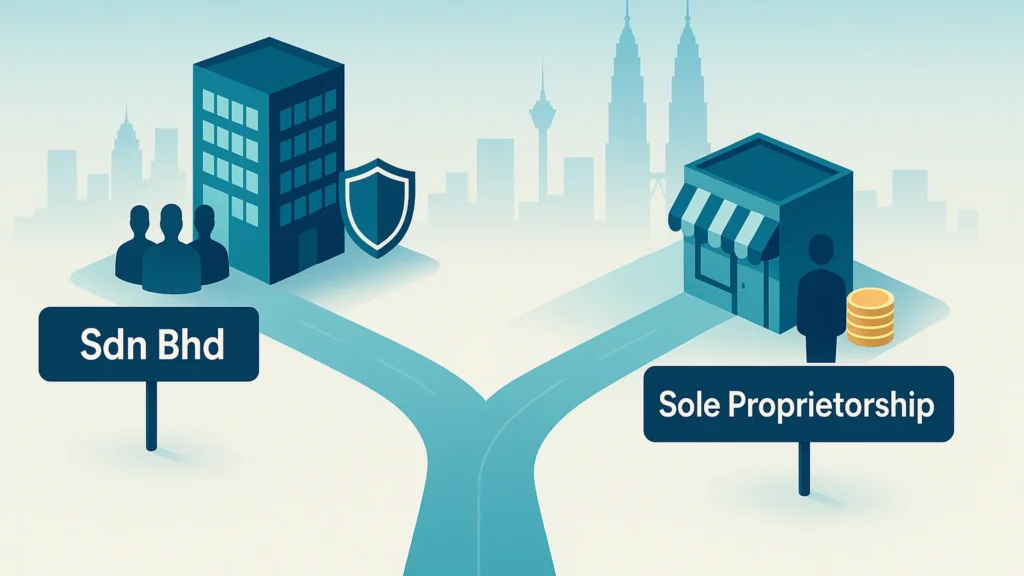

The critical question every Malaysian SME faces: When does incorporating a Sdn Bhd become more tax-efficient than operating as a sole proprietorship?
Our analysis shows: The break-even point typically falls between RM180,000–RM220,000 in annual profits when factoring in realistic compliance costs and director salary. For pure tax comparison, it’s closer to RM150,000–RM200,000.
Why this matters in 2025: SME company tax rates (15%/17%/24%) combined with salary optimization strategies can deliver substantial tax savings—but only if you structure correctly and meet qualifying conditions.
This guide provides the detailed analysis Malaysian business owners need to make informed structural decisions.
TL;DR (Read This First)
- Break‑even (pure tax): ~RM150k–RM200k annual profits.
- Break‑even (real‑world, after salary + compliance): ~RM180k–RM220k.
- Why: SME corporate bands 15% / 17% / 24% + the ability to split income between salary (deductible) and dividends.
Use this as a decision aid, not a substitute for personalised advice. Actual outcomes depend on your income mix, reliefs, SME eligibility, and growth plans.
Who This Guide Is For
Owners and founders of Malaysian SMEs who are:
- Weighing when to incorporate
- Already profitable and want a tax‑efficient compensation plan
- Planning for banking, financing, or investor readiness in the next 12–24 months
How Malaysia Taxes SMEs in 2025 (Quick Primer)
Corporate (Sdn Bhd) – SME Rates
- 15% on the first RM150,000 of chargeable income
- 17% on the next RM450,000 (i.e., up to RM600,000)
- 24% on the balance above RM600,000
Key SME eligibility checks:
- Paid‑up capital ≤ RM2.5 million
- Gross business income ≤ RM50 million
- Foreign ownership ≤ 20%
- Not controlled by / controlling companies that don’t qualify; resident status required
Individuals (Sole Proprietors / Partners)
- Progressive personal tax rates (up to 30% at the top bands)
- Personal reliefs apply; all business profits are taxed as your personal income (no deduction for your own “drawings”)
2025 Dividend Note
- A 2% tax applies to local dividends exceeding RM100,000 per individual per year. Factor this in if you rely heavily on big dividend payouts.
Where the Break‑Even Sits
A) Pure Tax Comparison (no salary; profits vs profits)
Assumes you qualify as an SME and ignores personal reliefs for simplicity.
| Profit (RM) | Sole Prop – Personal Tax (RM) | Sdn Bhd – Company Tax (RM) | Sdn Bhd Advantage (RM) |
|---|---|---|---|
| 100,000 | 9,400 | 15,000 | −5,600 |
| 150,000 | 21,900 | 22,500 | −600 |
| 200,000 | 34,400 | 31,000 | +3,400 |
| 300,000 | 59,400 | 48,000 | +11,400 |
Takeaway: The tipping point shows up around RM150k–RM200k. Above that, the SME bands start to win.
B) Realistic Operations (salary + running costs)
Assumptions: RM60k director salary (company‑deductible), RM8k annual compliance costs (audit, tax, secretary). Personal reliefs/EPF ignored for simplicity.
| Total Profit Before Director Salary (RM) | Sole Prop – Total Tax (RM) | Sdn Bhd: Co. Tax (post‑salary) + Your Personal Tax (on RM60k) + Compliance (RM) | Net Advantage vs Sole Prop (RM) |
|---|---|---|---|
| 150,000 | 21,900 | 13,500 + 2,600 + 8,000 = 24,100 | −2,200 |
| 200,000 | 34,400 | 21,000 + 2,600 + 8,000 = 31,600 | +2,800 |
| 250,000 | 46,900 | 28,500 + 2,600 + 8,000 = 39,100 | +7,800 |
| 300,000 | 59,400 | 36,000 + 2,600 + 8,000 = 46,600 | +12,800 |
Takeaway: Once we model a sensible salary and the real cost of staying compliant, the practical break‑even lands around RM180k–RM220k and widens in favour of a Sdn Bhd as profits grow.
What Moves Your Break‑Even
- SME eligibility: Losing SME status (e.g., foreign shareholding > 20%) pushes you up to the flat 24% rate—raising your break‑even.
- Salary level: Too low and you miss reliefs/EPF; too high and you push yourself into higher personal bands. There’s a sweet spot.
- Other personal income: Rental, investment, employment, spouse income—all can push you up the personal bands, making incorporation attractive earlier.
- Dividend strategy: If you plan > RM100k dividends per person, plan around the 2% top‑up.
- Compliance costs & sophistication: More entities, financing, and employees add cost—but also add reasons to incorporate (bankability, liability ring‑fencing).
Beyond Tax: Strategic Wins of Incorporation
- Limited liability: Ring‑fence personal assets from business risks
- Bankability: Higher credit limits, trade facilities, better equipment financing
- Professional credibility: Smoother access to tenders, supplier panels, and JV partners
- Operational clarity: Clean separation of business vs personal, better policies and audit trails
- Exit & succession: Share transfers, ESOPs, investor entry, family succession—all easier in a company
LBCO’s Step‑By‑Step Decision Framework
Phase 1 — Current State
- Annual profit trend
- SME eligibility check
- Your personal income mix & reliefs
- Industry‑specific risks
Phase 2 — Professional Modelling
- Detailed tax computation with your actual numbers
- Compliance roadmap & costs
- Salary / dividend mix optimisation
- Implementation timeline
Phase 3 — Execute
- Incorporate (if advantageous)
- Set up bookkeeping, payroll, HR, e‑invoicing
- Lock in compliance calendar (SSM, LHDN, SST where relevant)
- Review annually; adjust as you scale
Common Implementation Challenges and Solutions
Challenge 1: Timing the Transition
Problem: Many business owners wait too long to incorporate, creating complex asset transfer situations.
LBCO Solution: We help clients project their growth trajectory and incorporate at the optimal timing, avoiding later complications.
Challenge 2: Foreign Investment Complications
Problem: SMEs unknowingly accept foreign investment that pushes them above the 20% threshold, losing SME tax benefits.
LBCO Solution: We structure shareholding arrangements to maintain SME qualification while accommodating foreign investment needs.
Challenge 3: Salary vs Dividend Optimisation
Problem: Poor planning leads to suboptimal tax outcomes—either too much salary (higher personal tax) or too little (wasted reliefs).
LBCO Solution: We develop personalized salary/dividend strategies based on your total income picture and family tax planning needs.
Challenge 4: Compliance Overwhelm
Problem: SME owners underestimate the ongoing compliance requirements, leading to penalties and stress.
LBCO Solution: We provide complete compliance support, from monthly bookkeeping to annual audits, letting you focus on business growth.
What You Get with LBCO
- Incorporation to Audit, End‑to‑End: Company secretary, bookkeeping, payroll, tax, and other compliance requirements under one roof
- Advisory + Automation: Practical structures backed by streamlined workflows (e‑invoicing, payroll, HR)
- Growth‑Ready: Banking packs, investor‑ready financials, clean data for faster decisions
Talk to Us (No‑Pressure Consult)
WhatsApp Business Advisory: +6017‑440 9798
Incorporation service information & pricing: https://www.lbco.my/incorporation
Email: contact@lbco.my
Visit Us: 10A Jalan Centrepoint 2, Pinji Centrepoint, 31650 Ipoh, Perak
Last updated: 6 September 2025
Disclaimer: This guide reflects current Malaysian rules at time of writing and is for general information only. Outcomes vary by facts; obtain tailored advice before acting.