


Most Malaysian SMEs don’t pay too much tax because rates are too high. They pay too much because planning starts too late.
If I had to sum up the article in a few lines, it’s this:
- I need to check deductible expenses before year-end
- I should claim capital allowances instead of treating asset purchases as normal expenses
- I need to review whether RA or ACA applies before I invest
- I should plan director salary, bonus, fees, and dividends with the right paperwork
- I must keep records for at least 7 years
- And under self-assessment, many tax-saving choices need to be made before the basis period ends
One stat stands out: 65.4% of Malaysian SME respondents were unaware of tax incentives such as Reinvestment Allowance. That alone shows why many businesses miss legal tax savings.
Here’s the short version: if I want to cut my company’s tax bill, I need to act early, keep clean books, separate personal and business spending, and match each cost to the right tax treatment. A missing receipt, a late asset purchase, or the wrong pay method for directors can mean paying more tax than needed.
Quick comparison
| Area | What I should do | Common mistake | Tax effect |
|---|---|---|---|
| Expenses | Claim costs incurred wholly and exclusively for the business | Mixing personal and business spending | Missed or denied deductions |
| Asset purchases | Claim through capital allowances | Expensing laptops, vehicles, or machinery directly | Wrong claim, later adjustment |
| Incentives | Check RA or ACA before spending | Claiming the wrong relief or missing it | Higher chargeable income |
| Director pay | Use the right mix of salary, bonus, fees, and dividends | Poor approval records or wrong treatment | Lost deduction or audit issue |
| Recordkeeping | Keep invoices, payroll, bank records, and resolutions for 7 years | Missing support documents | Valid claims may be disallowed |
Put simply: tax planning is less about last-minute filing and more about year-end decisions made on time.
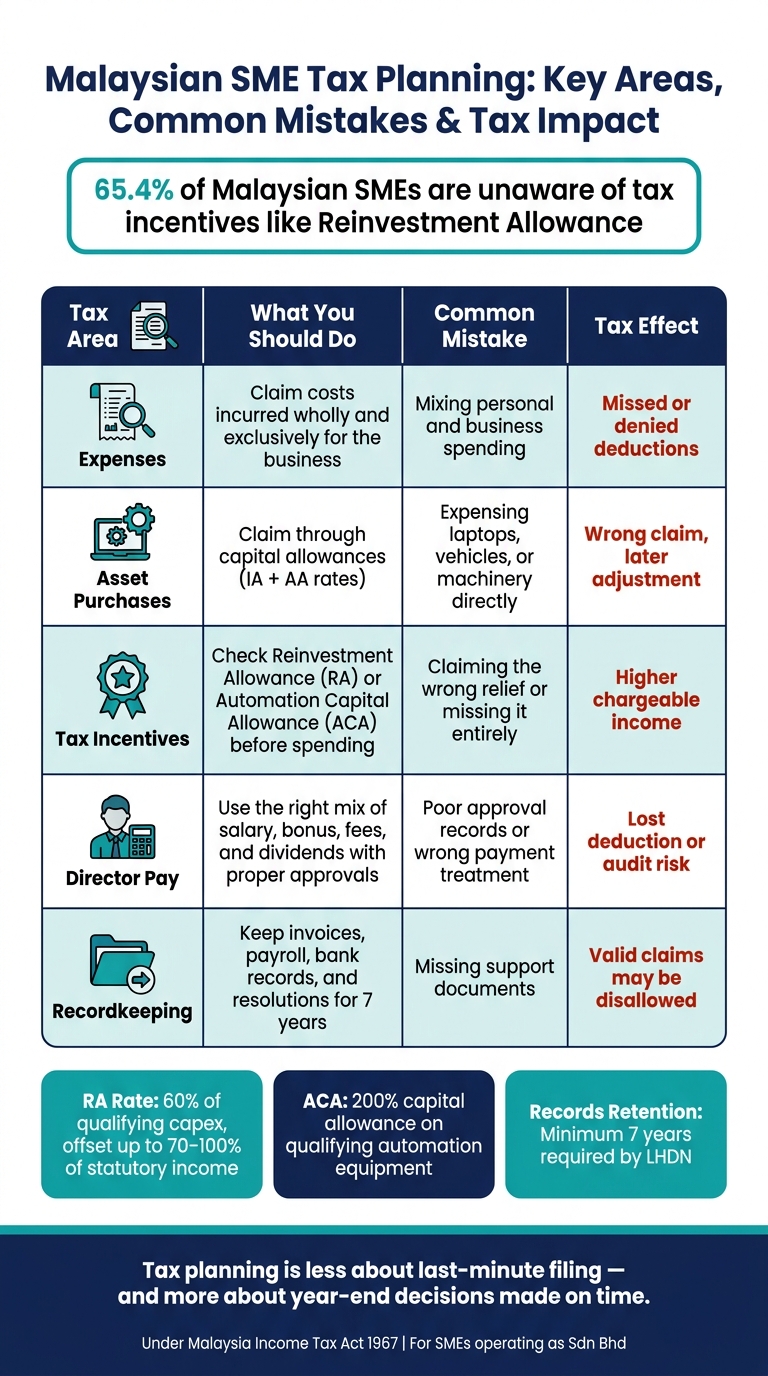
Malaysian SME Tax Planning: Key Areas, Common Mistakes & Tax Impact
How SMEs in Malaysia Can Have Better Tax Planning in 2021 – Richard William (RW William)
sbb-itb-ba278e7
Claim the deductions your business is entitled to
Every allowable expense reduces your taxable profit. Under Section 33(1) of the Income Tax Act 1967, only expenses incurred wholly and exclusively to earn business income are deductible. Start with day-to-day business costs, then look at assets and reliefs that may cut your tax bill further.
Common allowable expenses that reduce taxable profit
For many Malaysian SMEs, the main deductible expenses are fairly simple. Staff salaries, bonuses, and statutory contributions like EPF, SOCSO, and EIS are deductible business costs. The same goes for office rent, utilities such as electricity, water, internet, and telephone, plus marketing and advertising, software subscriptions, professional fees for accounting and audit work, staff training, repairs and maintenance that keep assets usable, and business travel with a clear business purpose and receipts.
If the expense is genuinely for the business and recorded properly, it can reduce taxable profit. Put simply, the more qualifying expenses you document, the less profit is left to be taxed.
Expenses that are disallowed or wrongly classified
Not every payment from the business account counts as a deduction. Personal, domestic, and capital expenses are usually not deductible, even when paid using company money.
A common slip-up is treating a vehicle purchase as a transport expense. It isn’t. That’s capital expenditure, not a normal operating cost, so it should be claimed through capital allowances over time instead. The same rule applies to fines and penalties, income tax, personal travel, and director’s private expenses. Those are disallowed.
| Expense Type | Allowable or Disallowed | Why | Documents Needed |
|---|---|---|---|
| Salaries, bonuses & EPF/SOCSO | Allowable | Directly related to business operations and income production | Payroll reports, EPF statements, Form EA |
| Office rent & utilities | Allowable | Necessary for business premises and operations | Tenancy agreement, utility bills, receipts |
| Marketing & advertising | Allowable | Incurred to generate business income and brand awareness | Invoices, digital receipts (e.g. Meta/Google Ads) |
| Professional fees (accounting, audit, legal for trade matters) | Allowable | Incurred for business compliance and ongoing operations | Invoices from service providers |
| Capital asset purchases (machinery, vehicles, furniture) | Not deductible as a direct expense | Capital in nature; must be claimed via capital allowances over time | Invoices, purchase agreements |
| Personal or private travel | Disallowed | Domestic/private nature; not incurred for business purposes | N/A |
| Entertainment (personal or unsubstantiated) | Partially disallowed | Strict rules apply; disallowed if personal or lacking business purpose | Receipts, attendee list, stated purpose |
| Fines, penalties & income tax | Disallowed | Do not meet the business-purpose test | N/A |
If you classify disallowed items as deductible expenses, LHDN may make adjustments and impose penalties and interest when reviewing your return. That’s the sort of error that looks small in your accounts but can sting later.
Records that support deduction claims
Even a valid expense can be denied if you can’t support it with documents. Keep invoices, receipts, contracts, payroll records, EPF/SOCSO schedules, and bank statements for each claim. Good recordkeeping also helps you spot missed deductions before the basis period ends.
A simple way to keep things tidy is to separate business and personal banking and use cloud bookkeeping software that stores digital copies of invoices and receipts with each transaction. That makes expense coding easier, helps you catch posting errors early, and gives you a clear audit trail if LHDN reviews your records.
Once your deductions are properly documented, the next area to look at is capital allowances and tax incentives for SMEs on asset purchases.
Capital allowances, reinvestment reliefs, and year-end timing decisions
Routine expenses can only take you so far. Some of the bigger tax savings come from how you deal with asset purchases, reinvestment plans, and the timing of major spending. Once deductions are sorted, the next area to watch is asset reliefs and when capital spending lands.
Capital allowances on equipment, machinery, and office assets
When your business buys a laptop, machinery, or office furniture, you can’t deduct the full cost as a normal business expense for that year. These are capital items, so they fall under capital allowances (CA) under Schedule 3 of the Income Tax Act 1967.
CA is usually claimed through an Initial Allowance (IA) in the first year and an Annual Allowance (AA) in later years. In general:
- Plant and machinery usually gets IA 20% and AA 14%
- Computers and ICT equipment are claimed faster at IA 20% and AA 40%
- Office equipment and furniture usually gets IA 20% and AA 10%
Small-value assets costing RM1,300 or less per item can be written off in full in the year of purchase.
To support a CA claim, keep a fixed asset register that shows each asset’s description, purchase date, cost, and proof of business use. Back this up with invoices and payment records. If the records are weak, the claim can be disallowed.
Reinvestment Allowance and other tax incentive options
If your business is in manufacturing or qualifying agricultural activities and has been operating for at least 36 months, you may qualify for the Reinvestment Allowance (RA). For a growing SME, the main point is simple: does the planned expansion qualify for extra relief?
RA is given at 60% of qualifying capital expenditure and is generally set off against up to 70% of statutory income. In some promoted regions, the set-off can go up to 100%. The incentive runs for 15 consecutive years of assessment from the first reinvestment. Any unused RA can be carried forward for up to 7 years after that period ends.
SMEs that are investing in automation may also look at Automation Capital Allowance (ACA), which gives 200% capital allowance on qualifying automation equipment. But here’s the catch: RA and ACA can’t be claimed on the same expenditure in the same Year of Assessment. So each qualifying asset needs to be mapped to the right incentive.
Timing decisions that can change your tax outcome
Timing matters more than many business owners think.
The Year of Assessment (YA) for a capital allowance claim depends on when the asset is bought and put into use. The same idea applies to repairs. Genuine repairs, meaning work that restores an asset rather than improves it, can be deducted as a revenue expense in the current YA if they are done before the basis period ends. Miss that timing, and the deduction may shift to the next YA instead.
A practical move is to run a pre-year-end tax review in October or November. Go through planned capital projects, check whether CA, RA, or ACA may apply, and line up purchase or commissioning dates with care. The aim isn’t to spend for the sake of tax relief. It’s to make sure spending you already need falls into the right year and is backed by proper records.
After asset planning, the next lever is how directors are paid and how the books are kept.
Director remuneration planning and bookkeeping for tax efficiency
After deductions and capital allowances, director remuneration is the next tax lever. How a company pays its directors shapes both taxable profit and cash flow. It also affects day-to-day compliance, so this isn’t just about tax savings on paper.
How salary, bonus, director fees, and dividends are taxed differently
For a working director in a Malaysian Sdn Bhd, there are four main ways to pay directors: salary, bonus, director fees, and dividends. Each one gets different tax treatment from LHDN, and that choice can change both the company’s taxable profit and the director’s personal tax position.
Salary, bonuses, and director fees are generally deductible for the company when they are properly approved and paid for business use. For the director, those payments are taxed as employment-related remuneration. Dividends work differently. They are paid out of after-tax profits, so the company can’t claim a deduction. But under Malaysia’s single-tier dividend system, they are generally not taxed again at shareholder level.
| Payment type | Company deduction | Personal tax effect | Documents required |
|---|---|---|---|
| Salary | Yes, if properly supported | Taxable as employment income | Employment contract, payroll records, payslip, PCB records; EPF, SOCSO, and EIS may also apply, depending on the payment |
| Bonus | Yes, if properly supported | Taxable as employment income | Board resolution or minutes, payroll records, payslip, payment proof; EPF, SOCSO, and EIS may apply depending on the role and payment type |
| Director fees | Yes, if genuine and properly approved | Taxable as remuneration | Board resolution, payroll records, PCB evidence, bank transfer records; EPF, SOCSO, and EIS may apply depending on the role |
| Dividend | No | Generally not taxed again under the single-tier system | Dividend declaration, shareholder records, proof of distributable profits, dividend voucher |
These tax outcomes only hold up when each payment has the right approval trail and proof of payment. Miss the paperwork, and even a normal payment can turn into a problem.
Director fees are taxed when credited, not when earned, and PCB must be remitted by the 15th of the following month. Undocumented payments can trigger audit risk even when the work was genuine.
Bookkeeping records that make tax planning work
Director remuneration only saves tax when approvals and payments are recorded properly. That’s the part many companies overlook.
Keep payroll files, board resolutions, payslips, PCB records, dividend vouchers, and bank transfer proof. For director remuneration, the file should also include employment contracts, board resolutions for director fees or bonuses, payslips, PCB payment evidence, and dividend vouchers or minutes where needed.
A simple way to handle this is to outsource payroll or keep payroll, dividend, and approval records in one file. When LHDN asks for support, you don’t want to be digging through old emails and mismatched folders.
Why regular reviews beat last-minute filing
Most tax issues start long before the return is filed. A salary not run through payroll, a bonus paid without a board resolution, or a dividend declared without checking distributable profits – that’s where trouble begins.
Regular reviews help spot these gaps while there’s still time to fix them. It’s much easier to clean up records month by month than to patch things up at year-end, when deadlines are near and key documents may already be missing.
Conclusion: The tax-saving steps that matter most
Tax planning isn’t something to think about only at year-end. The businesses that pay less tax tend to treat it as part of the normal routine: review the accounts often, keep records in order, and think about tax before the financial year ends. That’s what turns tax rules into clear year-end action.
The main steps are straightforward. Claim every deduction you’re allowed to claim. Track capital assets properly and claim capital allowances on time; any unutilised balance can be carried forward. Check whether your business qualifies for tax incentives before you commit to new investments. Reliefs such as Reinvestment Allowance and Automation Capital Allowance can cut your tax bill, but only if you plan early and keep the right records.
The same approach applies to director remuneration. Use a clear and well-documented mix of salary, fees, and dividends. Back it up with board resolutions, payslips, and payroll records so both the company and the director are covered.
None of this holds up without complete records. Keep full records for at least seven years. Tax planning only saves money when the paperwork supports it. A lot of SME tax trouble starts with weak record-keeping and expenses filed under the wrong category. Good bookkeeping is what turns a tax plan into actual savings.
Start early. Review often. Keep the paperwork right.
FAQs
When should I start tax planning?
Start tax planning well before your year-end filing deadlines. This isn’t something to leave until the eleventh hour. It works best as a year-round habit.
Regular financial reviews, ideally every quarter or at least twice a year, can help you spot tax-saving opportunities early. They also make it easier to fine-tune salary and dividend structures, manage cash flow, and keep your records in order for LHDN compliance.
How do I know if an expense is deductible?
An expense is usually deductible when it has a direct link to earning your business income. Common examples include employee salaries, office rent, utilities, business supplies, professional fees, and marketing costs.
Keep detailed records for at least seven years. That means invoices, receipts, and payment details should all be kept in order. Personal expenses and business drawings are usually not deductible, and your records should line up with payroll and statutory documents to meet LHDN requirements.
Should I claim RA or CA?
Whether you should claim Reinvestment Allowance (RA) or Capital Allowance (CA) comes down to your business activity, the type of capital spending involved, and whether you qualify for a growth-based tax incentive.
This isn’t always straightforward. The rules can get a bit tricky, especially when you’re looking at eligibility, timing, and what kind of assets or projects fall under each claim.
Because of that, it’s smart to speak with a tax professional. They can help you confirm eligibility, keep the right supporting documents, and make sure the claim matches your tax position while staying in line with LHDN rules.