


A Malaysian Sdn Bhd can have just one shareholder. My starting point: choose sole ownership if you want control in one place, or multiple owners if you want to share funding and expertise. Agree on contributions, voting rights and exit terms before committing.
Here’s how I compare the two setups:
Quick Comparison
| Factor | Single shareholder | Multiple shareholders |
|---|---|---|
| Ownership and control | One owner holds 100% of issued shares. | Share rights and voting rules determine control. |
| Funding | Depends on one owner or outside finance. | Owners can pool funds on agreed terms. |
| Decisions and disputes | Fewer people to consult. | More coordination; a 50:50 vote can lead to deadlock. |
| Personal risk | Liability is generally limited to unpaid shares. | The same rule applies to each owner. |
| Bank access | Requires company approval and bank acceptance. | Share ownership alone does not give account access. |
| Records and compliance | Standard records and filings still apply. | Each owner’s holdings and ownership changes need recording. |
| Succession and exits | Plan for the owner’s absence or death. | Agree on transfers, exits and buy-out terms. |
| Adding owners | New shares or transfers can reduce sole control. | New shares or transfers can change the voting balance. |
Either way, the company remains separate from its owners. Guarantees and unlawful conduct can still create personal exposure.
Before a new owner joins, I would check <u>who receives the money</u>: a cash share issue funds the company; a share transfer generally pays the seller. Then confirm approvals, update ownership records and review bank access.
Single vs Multiple Shareholders: Ownership and Funding
| Factor | Single shareholder | Multiple shareholders |
|---|---|---|
| Ownership | One owner holds all issued shares. | Ownership can be equal or unequal, with majority and minority interests. |
| Capital contributions | Funding depends on one owner’s funds. | Owners can pool funds but must agree on who contributes and on what terms. |
| Decision speed | Fewer discussions, but statutory approvals and records still apply. | Voting rights and approval rules shape the process; disagreements can delay action. |
| Accountability | Responsibility sits clearly with one owner, but there may be little internal challenge. | Shared accountability supports closer scrutiny when roles are clear. |
Single Shareholder: Full Ownership and Reliance on One Owner
Sole ownership makes funding and reinvestment decisions simpler. But it also concentrates voting and succession risk in one person. Treat each cash injection as either equity or a shareholder loan, and record it accordingly.
Having one shareholder does not remove the need for records, resolutions, annual filings or compliance with directors’ duties. Dividend decisions must still meet legal and financial requirements.
Multiple Shareholders: Shared Funding and Disputes
An equal split gives shareholders the same stake only if their shares carry identical rights. Different share classes can have different voting, dividend and capital rights, so ownership percentages alone do not show who controls the company.
Document funding commitments, minority rights and how disagreements will be handled. Agree on funding terms before the company needs more capital, rather than leaving them open to dispute later.
Keep salary and dividends separate: salary pays for work, while dividends depend on share rights and profits. Agree on who approves remuneration, how much profit to reinvest and what happens if an owner cannot contribute more funds. Unpaid work does not create extra shares.
Agreeing on the Share Split Before Incorporation
Prepare a cap table showing each owner’s number of shares, share class, ownership percentage and agreed consideration. Record what each person will contribute and when. Specify whether each contribution is equity, a loan, a licence or a service obligation, with separate contracts where needed.
Percentages matter, but the constitution and share class terms can change voting, dividend and capital rights. Set out what happens if promised funding falls through, a founder stops work or a new investor joins. These ownership terms provide the basis for voting, approval rights and exit terms.
Once the split is agreed, address who can block decisions, grant approvals or transfer control.
sbb-itb-ba278e7
Control, Voting and Shareholder Agreements
Once the share split is settled, the next step is deciding who controls company decisions. Ownership percentage and control can differ.
| Issue | Single shareholder | Multiple shareholders |
|---|---|---|
| Control over member votes | The sole shareholder controls member resolutions, subject to the Act, constitution and share rights. | Control depends on voting rights and any higher approval requirements. |
| Management authority | Directors manage contracts and operations; ownership alone does not grant signing power. | The same applies; majority ownership does not grant signing power. |
| Approval process | Required resolutions, notices and records still apply. | Notices, proxies, voting and written resolutions need coordination. |
| Deadlock risk | Low at shareholder level, though disputes with directors can arise. | Higher with equal or near-equal voting power. |
Shareholder Rights vs Director Duties
Shareholders exercise ownership rights, while directors manage the company – even when the same person holds both roles. Company assets remain separate from personal assets.
Voting Thresholds and 50:50 Deadlock
An ordinary resolution needs more than 50% of the relevant voting rights. A special resolution needs at least 75% and must be identified as a special resolution. For private companies, written resolutions follow the same threshold as a meeting. Meetings for special resolutions require at least 21 days’ notice, unless a permitted shorter-notice procedure applies.
For meeting votes, count members entitled to vote who attend or appoint proxies, subject to the Act and constitution. If two owners have equal voting rights, neither can pass a contested shareholder resolution when they vote differently.
A casting vote may settle a board tie if the constitution allows it, but it does not automatically settle a 50:50 shareholder vote. Reserved matters may also require approval above the statutory minimum.
Put the voting, approval and exit rules in writing.
Recording Approvals, Share Transfers and Exits
A shareholders’ agreement should cover reserved matters, future funding, director appointments, information rights, transfer restrictions, exit valuation and payment terms. Specify the approvals needed for borrowing, major asset sales and related-party transactions.
Agree on negotiation, mediation and a final exit mechanism before a dispute arises. Read the agreement alongside the constitution and share rights: it cannot override mandatory statutory requirements.
Keep signed board and shareholder resolutions, notices, voting records and clear signing mandates. Put authority to act into effect through board approvals, and tell banks and suppliers who can sign. Internal restrictions may not bind third parties who rely on apparent authority.
Have a Malaysian company secretary or lawyer confirm the voting basis and approval procedure before acting. Before transferring shares, check consent requirements, pre-emption rights, stamp duty and registration.
Liability, Ownership Records and Bank Accounts
Once control and approval rules are in place, the next issues are personal risk, bank access and ownership records.
| Area | Single shareholder | Multiple shareholders |
|---|---|---|
| Personal risk | Guarantees, misconduct and director duties can expose the owner to personal liability. | The same risks apply to each owner. Owning shares alone does not make owners jointly liable for company debts. |
| Banking authority | The sole shareholder may be an authorised signatory, subject to company authorisation and bank acceptance. | Account access is not automatic. Joint approval or transaction limits can help reduce control risk. |
| Ownership records and disclosure | One member’s holdings and ownership changes still require formal records. The registered shareholder and beneficial owner may be the same person. | Each member’s holdings, rights and ownership changes require coordinated records and approvals. Ultimate control may differ from registered ownership. |
Limited Liability and Personal Risk
Liability is generally limited to unpaid share capital. But personal guarantees, fraud, misuse of company assets and breaches of director duties create separate exposure. Review guarantees separately from share ownership: limited liability does not cancel a guarantee.
Sole ownership puts funding and succession risk on one person. Plan for illness, incapacity or death, especially if that person is also the only authorised signatory. Multiple owners may reduce dependence on one person, but unequal contributions and minority-protection concerns still need attention.
Bank Documents and Account Access
Banks typically ask for incorporation, business and ownership information; identification for relevant directors, shareholders, beneficial owners and authorised signatories; account-access documents; and details of funding sources and expected transactions. Signing authority depends on board approval and bank rules, not the number of shareholders.
Share Registers and Ownership Disclosure
Keep allotments, transfers and payment records consistent with the register of members. Support them with subscription terms, approvals, transfer instruments and applicable filings. These records establish existing holdings for later transfers or the admission of new shareholders. One shareholder means fewer entries – not fewer compliance duties.
A registered shareholder holds shares on record. A beneficial owner is the individual who ultimately owns or controls the company, directly or indirectly. In a simple sole-owner company, these may be the same person. They can differ when shares are held through a nominee, holding company, trust or layered ownership structure.
Under the Companies Act 2016 framework, the company must take reasonable steps to identify, verify and record accurate, up-to-date beneficial ownership information. It must also retain supporting documents.
The company and its directors remain responsible for accurate information and meeting their obligations. These records must be updated before any new shareholder joins.
Adding Shareholders After Incorporation
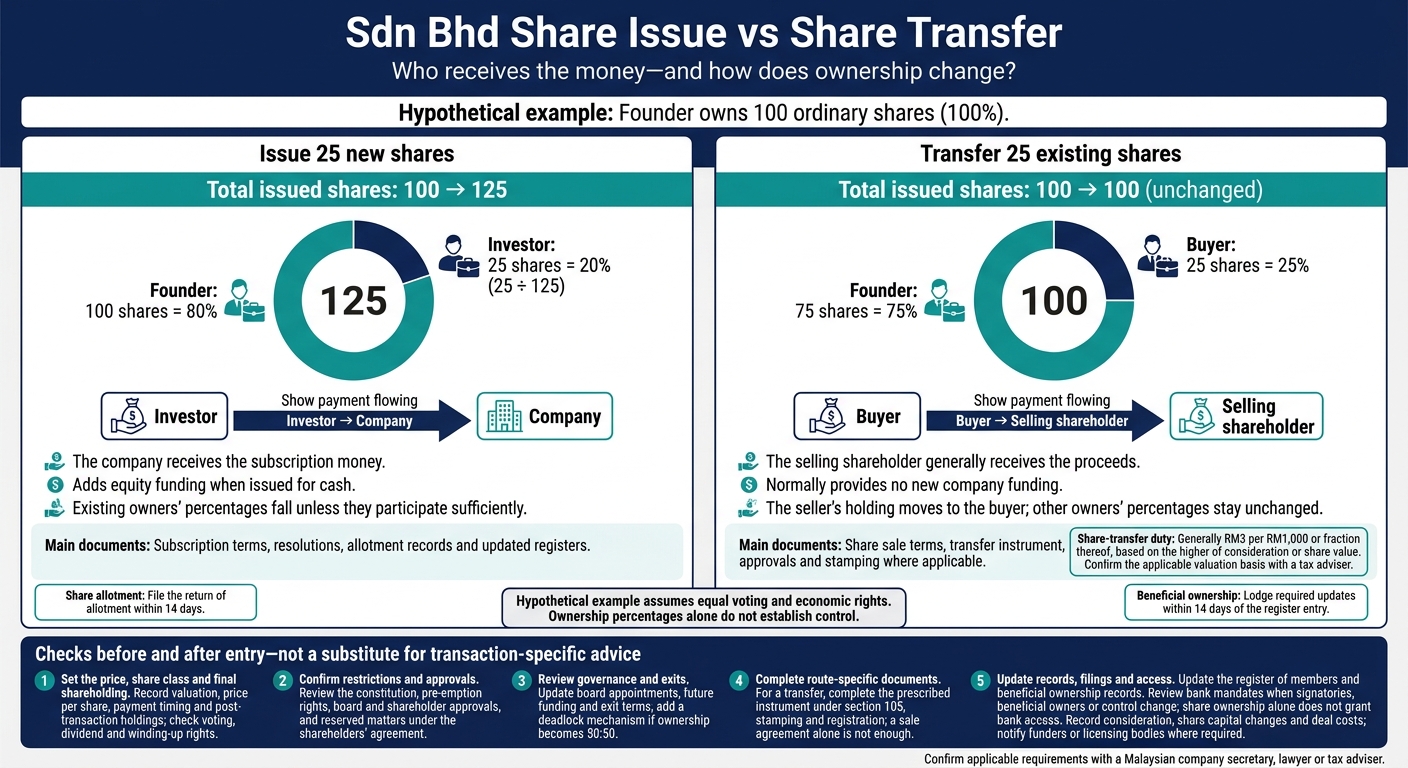
Sdn Bhd Share Issue vs Share Transfer
Once control and banking authority are clear, decide how the new owner will join: through a share issue or share transfer. Either route can reduce a sole owner’s control or change the balance among existing shareholders.
| Consideration | Starting with one shareholder | Starting with multiple shareholders |
|---|---|---|
| Initial ownership | One person owns 100% of the issued shares. | Ownership follows the agreed split, such as 60:40 or 50:50. |
| Dilution from new shares | The owner’s percentage falls unless they subscribe sufficiently. | Existing owners are diluted unless they participate sufficiently or agree otherwise. |
| Required approvals | Board and shareholder approvals may be needed under the Act, constitution and shareholders’ agreement. | Board approvals, pre-emption rights and reserved matters may apply. |
| Control after entry | A large new voting stake can reduce the sole owner’s control. | Voting balance, board appointments and deadlock rules may need revision. |
Issuing New Shares vs. Transferring Existing Shares
Choose based on who should receive the money: the company or the seller. The route also affects dilution and control, so confirm the required approvals before signing.
| Feature | Issuing new shares | Transferring existing shares |
|---|---|---|
| Total issued shares | Increases. | Remains unchanged. |
| Dilution | Existing owners’ percentages fall unless they participate sufficiently. | The seller’s holding moves to the buyer; other owners’ percentages stay unchanged. |
| Who receives payment? | The company receives the subscription money. | The selling shareholder generally receives the proceeds. |
| Company funding | Adds equity funding when issued for cash. | Normally provides no new company funding. |
| Main documents | Subscription terms, resolutions, allotment records and updated registers. | Share sale terms, transfer instrument, approvals and stamping where applicable. |
Hypothetical example: A founder holds 100 ordinary shares. Issuing 25 new shares to an investor creates 125 shares: the investor owns 20% (25 ÷ 125) and the founder retains 80%. This assumes equal voting and economic rights. Transferring 25 of the existing 100 shares instead gives the buyer 25%, with payment generally going to the founder.
Checks Before a New Owner Joins
Set the price, share class and final shareholding before completion. Record the valuation, price per share, payment timing and post-transaction holdings. Look beyond percentages: check voting, dividend and winding-up rights too.
Review constitutional restrictions, pre-emption rights and required approvals. Introduce or revise the shareholders’ agreement to cover board appointments, reserved matters, future funding and exits. If ownership becomes 50:50, add a deadlock mechanism.
For a transfer, the sale agreement alone is not enough. Complete the prescribed instrument under section 105, along with stamping and registration. Share-transfer duty is generally RM3 per RM1,000 or fraction thereof, based on the higher of consideration or share value. Confirm the applicable valuation basis with a tax adviser.
After entry, update ownership records and bank access arrangements. For a share allotment, file the return of allotment within 14 days. Update the register of members and beneficial ownership records after an allotment or transfer. Lodge required beneficial ownership updates within 14 days of the register entry.
Update bank mandates when signatories, beneficial owners or control change. A share transfer alone may not change bank access. Record the consideration, any share capital change and deal costs in the accounts. Notify funders or licensing bodies where contracts or regulatory conditions require disclosure of ownership or control changes.
Conclusion: Choosing Your Shareholder Setup
Choose a shareholder structure that fits how you’ll run the company, weighing control, funding, bank access and future ownership changes. A single shareholder keeps control in one place and allows faster decisions. Multiple shareholders can pool capital and expertise while sharing governance.
| Setup | Suitable for | Main risks | Key safeguards |
|---|---|---|---|
| Single shareholder | A founder who wants full control, quick decisions and simple ownership | Dependence on one person; disruption during succession | Continuity plan, updated records, authorised bank signatories, and a succession or sale plan |
| Multiple shareholders | Businesses sharing capital, expertise, contacts and operating roles | Disputes, deadlock and conflict over exits | Shareholders’ agreement, reserved matters, voting thresholds, transfer restrictions, dispute process and buy-out provisions |
| Multiple shareholders with a 50:50 split | Equal owners with agreed rules for decisions and disputes | Decision deadlock | Deadlock clause, mediation or arbitration, and buy-out provisions |
Use this comparison to check how each setup would work for your business.
Selection Checklist and Setup Support
Before deciding, review control, funding, decision speed, expertise, succession, future ownership and exit terms.
A single-shareholder setup suits a founder who funds the business and wants control, provided there’s a continuity plan. Multiple shareholders make sense when capital, expertise or responsibilities are shared – but decision-making rules, transfer restrictions and exit terms need to be documented.
Put the agreed structure in writing before incorporation or any ownership change.
LBCO can help with Sdn Bhd incorporation, bank account opening, accounting, taxation, payroll and compliance. For tailored shareholders’ agreements, succession arrangements or complex ownership structures, seek qualified legal advice.
FAQs
Can I remain the sole director after adding shareholders?
Yes. Under the Companies Act 2016, shareholding and directorship are separate roles. You can add shareholders to your Sdn Bhd without appointing new directors.
At least one director must remain ordinarily resident in Malaysia at all times. If you appoint additional directors later, ask your company secretary to update your statutory records so your SSM filings stay accurate.
How can I protect my rights as a minority shareholder?
Set clear shareholder agreements and share structures from the start. Use a tailored Constitution to formalise special investor rights, and avoid unusual share classes unless a term sheet requires them.
A Sdn Bhd provides limited liability, keeping company interests separate from your personal assets. Record your rights in official company documents, and have your company secretary keep accurate registers as proof of ownership and legal standing.
What happens to my shares if I die?
When you die, your shares in a Sdn Bhd become part of your estate. They can pass to your beneficiaries or heirs under your will or inheritance laws. The company continues to exist as a separate legal entity through perpetual succession.
LBCO provides company secretarial support, including share transfer documentation, to help manage the transition and maintain compliance with the Companies Act 2016.