


If your books are late, payroll keeps going wrong, or you still use your bank balance to judge profit, your finance setup is likely too small for your business now. In many Malaysian SMEs, the warning signs show up before a bigger problem hits: missed SST filings, payroll errors, cash shortfalls, MyInvois issues, or SSM penalties.
I’d sum it up like this: if you spot two or more of the signs below, it may be time to move bookkeeping, payroll, tax, and compliance work to an outside team. This matters because many Malaysian SMEs have only about two months of cash buffer, while customer payments can take 64 days or more. That gap can hurt fast when records are weak.
Here are the 7 signs covered in this article:
- Your books are always behind or messy
- You cannot clearly see your cash flow or true profit
- Payroll mistakes keep happening
- Tax or SST filings are often late or inaccurate
- Important Sdn Bhd compliance deadlines are being missed
- Your business is not ready for e-invoicing
- The founder is spending too much time on finance admin
What this means in plain English:
If finance work depends on spreadsheets, memory, WhatsApp messages, or late-night founder catch-up, the risk is no longer small. The fix is usually a set monthly process: up-to-date books, payroll checks, filing deadlines, cash flow reports, and MyInvois-ready invoicing.
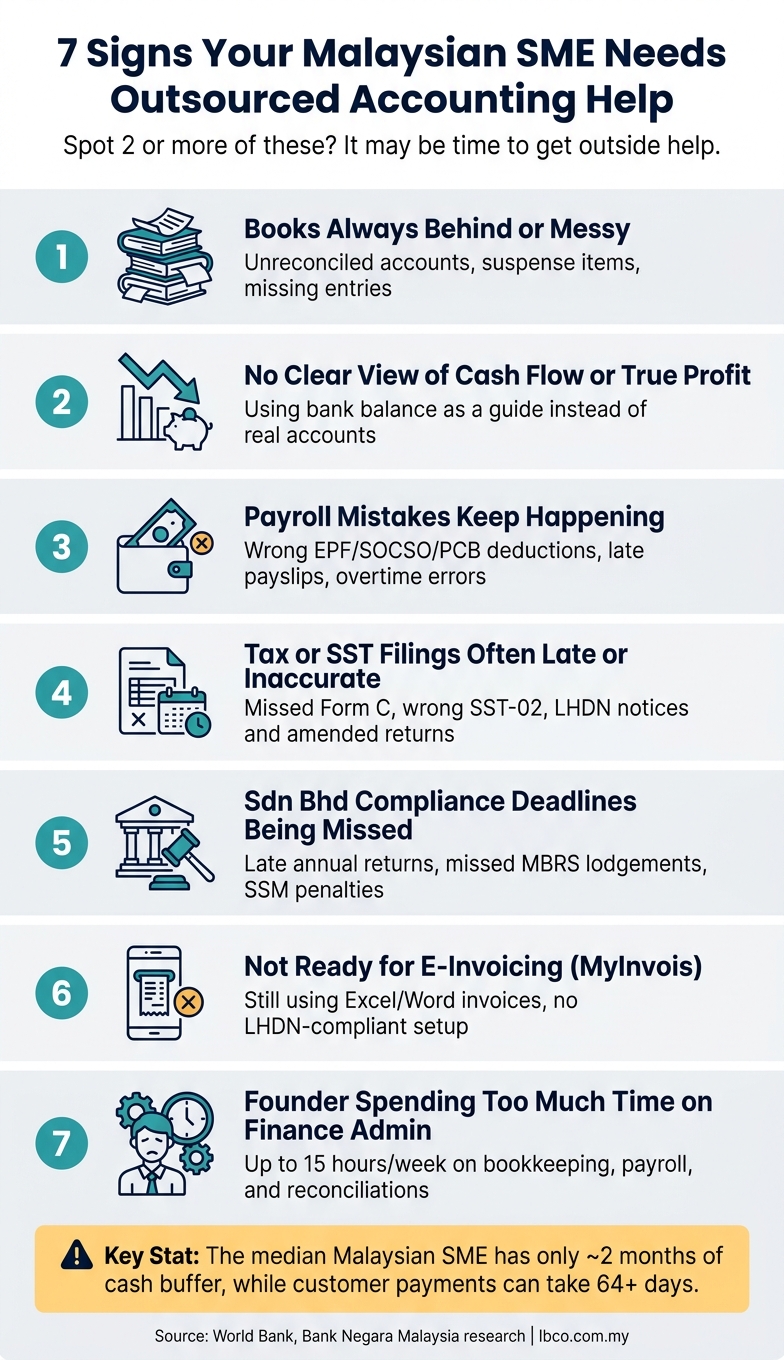
7 Signs Your Malaysian SME Needs Outsourced Accounting
Quick Comparison
| Sign | What it usually looks like | What outside help usually covers |
|---|---|---|
| Books behind | Unreconciled bank accounts, missing entries, suspense items | Backlog clean-up and monthly bookkeeping |
| Cash flow unclear | Using bank balance as the main guide | Monthly accounts and short-term cash forecast |
| Payroll errors | Wrong deductions, overtime mistakes, late payslips | Payroll processing and statutory submissions |
| Tax/SST issues | Late Form C, wrong SST-02, amended returns | Tax support, SST filing, deadline tracking |
| Sdn Bhd deadlines missed | Late annual return, late MBRS lodgement, missed updates | Compliance calendar and co-ordination |
| Not ready for e-invoicing | Excel invoices, weak customer records, manual MyInvois work | E-invoicing setup, data clean-up, monthly support |
| Founder stuck in admin | Evenings spent checking payroll, receipts, reconciliations | Managed monthly finance support |
Bottom line: when finance work starts slowing decisions, draining founder time, or putting filings at risk, outsourced accounting usually shifts from “optional” to the next sensible step.
sbb-itb-ba278e7
Why This Matters for Malaysian SMEs
A healthy bank balance can give a false sense of comfort. It doesn’t show unpaid invoices, tax bills, or statutory costs that are about to fall due. Behind that one number are supplier payments, KWSP and PERKESO contributions, SST liabilities, and loan repayments. Those only become obvious when the cash has to go out. Many Malaysian firms run with only a two-month cash buffer. That’s why weak records, not just weak sales, often show up as the first red flag.
The trouble usually starts quietly. Late tax, PERKESO, and SSM filings can trigger penalties, interest, and fines. In most cases, the first sign isn’t some dramatic business collapse. It’s a missed deadline.
Poor records also make growth harder. Studies from Bank Negara Malaysia and academic research show that thin documentation and weak financial records are among the main reasons SME financing applications get rejected. So even if the business is doing well on the ground, outdated books can make a bank loan or investor round much tougher to get. Better records help owners make better calls, and that often leads to stronger business performance.
This is where outsourcing can make a big difference. It gives SMEs up-to-date records and deadline tracking without the cost of adding a full-time hire. One Perak-based packaging company outsourced bookkeeping, payroll, and tax submissions, following a payroll outsourcing guide to ensure accuracy, which freed the founder to spend more time on sales. Less admin. More focus on running the business. Fewer compliance slip-ups.
The clearest warning sign? Your books are already behind.
1. Your books are always behind or messy
Operational warning sign
If your bookkeeping is already weeks behind, take that as the first clear warning sign.
This usually starts small. A few invoices don’t get entered. Bank statements sit unreconciled for a month. Petty cash ends up being tracked in WhatsApp messages. Then it snowballs.
You might also notice things like:
- system balances not matching bank statements
- transactions sitting in suspense accounts because nobody had time to sort them
- sales invoices created in Word or Excel but never posted into the accounting system
When that becomes normal, the accounts stop being dependable. And if the numbers can’t be trusted, decisions get shaky too.
Business or compliance impact
Late or incomplete records can put you at risk of breaching Companies Act 2016 and LHDN record-retention rules, which require records to be kept for 6 to 7 years depending on entity type.
Messy books also make it hard to see what’s actually going on in the business. You may think margins are fine, cash flow is under control, or expenses are in line, when the records tell a different story. Accurate bookkeeping is linked to better profitability and efficiency.
Practical Malaysian SME example
This is the point where outsourcing stops being just an admin move and becomes a clean-up job.
A Kuala Lumpur-based retail and e-commerce SME left bank feeds and payment gateway settlements unreconciled for months. That led to supplier invoices going unrecorded and cost of goods sold being understated. By the time the company needed up-to-date financials, the issues had piled up so much that a full bookkeeping clean-up had to be done before any dependable numbers could be produced.
That’s what happens when a business outgrows DIY finance, but the process doesn’t catch up.
Relevant outsourced accounting solution
A sensible fix is to start with a 6- to 12-month clean-up, then move into a fixed monthly close. That means reconciling accounts, clearing suspense entries, and closing management accounts by a set date every month.
For a Perak-based flexible packaging manufacturer, outsourcing bookkeeping, payroll, and tax submissions to a professional firm freed the founder to focus on sales and operations, eventually scaling the business to over 40 employees with clear visibility on financial performance.
Once the backlog is cleared, monthly bookkeeping helps stop the same mess from creeping back in.
2. You cannot clearly see your cash flow or true profit
Operational warning sign
Once the books are tidy, the next issue is simple: do they show what’s happening to your cash, and do they give you numbers you can use to run the business?
If you’re using your bank balance to decide what you can spend, that’s a red flag. It usually means you don’t have a clear view of cash flow. There’s no forecast, no proper receivables view, and no 30- to 90-day picture of what’s due in and what’s due out.
On the ground, this often looks like nasty surprises. Sales seem strong, but there still isn’t enough cash to pay a supplier. Or you’re not sure whether last month made money after rent, salaries, EPF, SOCSO, and SST are included. Many founders also struggle to answer basic questions such as:
- What is our monthly breakeven point?
- Which customers still owe us money?
- How much cash do we need over the next 30 to 90 days?
Business or compliance impact
When cash flow is unclear, it becomes much easier to miss statutory tax and regulation payments. EPF, SOCSO, EIS, and tax instalments all need cash to be set aside ahead of time. Malaysian SMEs often wait around 64 days for payment, and transport and logistics firms can wait 76 days. That delay between sending an invoice and getting paid is where many businesses start to slip – especially when no one is looking ahead.
The problem gets worse when profit visibility is weak. Without accrual-based bookkeeping, many SMEs only get a rough profit number at year-end, after key calls on pricing, hiring, and expansion have already been made. On paper, the business may look profitable. In practice, it may be running short on working capital.
A World Bank review notes that the median Malaysian SME has only two months of cash flow available before hitting shortages, highlighting how thin most firms’ buffers are.
Practical Malaysian SME example
A common Malaysian F&B mistake is opening a second outlet after seeing strong daily sales. It feels like the first outlet is doing well, so the next step seems obvious. Then the full picture shows up later: food cost, wastage, overheads, and SST have eaten into the margin, and there isn’t enough left to support expansion.
Relevant outsourced accounting solution
The fix is monthly management accounts, not a once-a-year look after the damage is done. That usually includes:
- profit and loss
- balance sheet
- cash flow
- aged receivables
- a short-term forecast
For Malaysian SMEs, this also means building SST liabilities, loan repayments, and statutory contributions into the cash view from the start, instead of treating them like end-of-month surprises.
3. Payroll mistakes keep happening
Operational warning sign
Recurring payroll mistakes usually point to a broken process, not a one-off error.
This tends to happen when a business has moved past DIY payroll or founder-led admin, but the process hasn’t caught up yet. The cracks start to show in places like overtime calculations under the Employment Act, old wage rates after a minimum wage update, wrong EPF, SOCSO, EIS, or PCB deductions, and uneven handling of new hires and staff exits.
In many SMEs, the root cause is pretty simple: payroll is still being managed in spreadsheets, rates aren’t updated on time, and there’s no second check before salaries go out.
Business or compliance impact
Mistakes in EPF, SOCSO, EIS, and PCB can lead to fines, interest, and audits. Staff trust can also drop fast when payslips or deductions are wrong.
Practical Malaysian SME example
This often shows up when headcount grows faster than payroll processes.
A small team might get by with manual payroll for a while. But once more staff come in, overtime hours pile up, and people join or leave more often, the old setup starts to wobble. One missed rate update or one wrong deduction formula can snowball into a messy payday.
Relevant outsourced accounting solution
Outsourced payroll services give SMEs a repeatable process for calculations, approvals, and statutory submissions.
That usually includes:
- a fixed cut-off date for attendance and overtime data
- current Employment Act rules and statutory rates applied to each payroll run
- a second review before salaries are released
- payslips generated together with EPF, SOCSO, EIS, and PCB reports
The process also builds in key statutory deadlines. EPF and PCB are due by the 15th of the following month, while SOCSO and EIS are due by the last day of the following month.
Payroll records, payslips, and contribution submissions are then stored digitally for at least seven years.
Once payroll is under control, the next pressure point is usually tax and SST filing.
4. Tax or SST filings are often late or inaccurate
Operational warning sign
Repeated late or inaccurate tax and SST filings usually point to a finance process that’s breaking down.
The red flags are pretty clear: Form C filed late, SST-02 prepared using incomplete figures, missed CP204 estimates, or repeat notices from LHDN or Customs. If you keep amending returns that were already filed, that’s another sign the monthly accounts aren’t being closed properly.
And if the team still depends on spreadsheets and a year-end cleanup to sort things out, the business has already outgrown a DIY setup.
Business or compliance impact
Late SST and tax filings can lead to penalties, surcharges, and possible enforcement action. When these issues keep happening, audit risk also goes up. On top of that, it can affect bank relationships, grants, tenders, and investor confidence.
Practical Malaysian SME example
Take a growing Sdn Bhd trading company. As sales climb, it crosses the SST registration threshold. When the SST-02 deadline comes around, the return is filed using incomplete records, and some invoices end up in the wrong period. Customs spots the mismatch and sends a notice.
At the same time, Form C is submitted based on draft accounts that still contain unresolved SST errors. That leads to LHDN queries and an amended return. The unpaid tax balance then gets hit with a 10% late payment surcharge.
Relevant outsourced accounting solution
Outsourced accounting shifts the business away from last-minute filing and into a proper monthly process. Books are closed every month, so the figures are reconciled before submission. There is also a compliance calendar for SST-02, Form C, CP204, and payroll compliance deadlines, which helps make sure nothing slips through.
Once tax and SST are under control, the next warning sign is often missed Sdn Bhd compliance deadlines.
5. Important Sdn Bhd compliance deadlines are being missed
Operational warning sign
Once tax filing is under control, SSM compliance can still be the next thing to slip. In many Malaysian Sdn Bhd companies, deadline tracking lives in one person’s head or inside a WhatsApp chat. There’s no shared calendar, no clear owner, and no alert system.
The pattern is common. The annual return to SSM gets remembered only after the company secretary sends a reminder. Financial statements go to shareholders after the 6-month deadline. Changes to directors or the registered office are not filed within the required 14 days. On top of that, responsibility is often split in a messy way between the founder, accountant, and secretary.
Sdn Bhd deadlines also don’t all follow the same timeline, which is where things start to get messy. The annual return is due within 30 days of each incorporation anniversary. Financial statements must be circulated within 6 months of financial year end, then lodged with SSM through MBRS within 30 days of circulation. Form C must be filed within 7 months of financial year end.
Business or compliance impact
When these dates are tracked by hand, one missed reminder can snowball into penalties. Late annual returns usually lead to RM50 to RM200 in late lodgement fees, while statutory penalties can go up to RM50,000, with continuing fines of up to RM1,000 per day in some cases. If annual returns are missed for 3 straight years or more, SSM may strike the company off the register.
And the problem doesn’t stop at fines. Poorly kept SSM records can come back to bite during a bank credit review or a funding round. Lenders and investors often compare filed documents against what the company submits. If the details don’t match, approvals can slow down or the facility size may be cut.
Practical Malaysian SME example
A Klang Valley trading Sdn Bhd with annual revenue of about RM5 million treated compliance as a once-a-year job. Its financial statements were circulated to shareholders 8 months after financial year end, then lodged with SSM more than 60 days after circulation. Changes to directors and a registered office move were also not filed within the required 14 days. SSM then issued multiple compounds totalling tens of thousands of ringgit. Later, when the company applied for a higher bank overdraft, the credit team found mismatches between SSM records and the company’s submission. That delayed approval and reduced the facility size. The founder then had to spend time chasing documents and answering SSM queries instead of running the business.
Relevant outsourced accounting solution
Outsourced accounting support helps by putting a clear compliance calendar in place based on the Sdn Bhd’s incorporation date, financial year end, and tax profile. Key deadlines such as the annual return, financial statement circulation, MBRS lodgement, and notifications for director or address changes are tracked ahead of time, with reminders sent well before each due date.
The outsourced team also works closely with the company secretary and auditors so documents and approvals are ready when needed. For the founder, this turns compliance from last-minute scrambling into a fixed monthly routine. The outsourced team drives the timetable, while the founder mainly reviews and signs off.
6. Your business is not ready for e-invoicing
Operational warning sign
Once deadline pressure is under control, the next problem usually shows up in invoice capture.
This is a common weak spot for Malaysian SMEs. Many still issue invoices through a patchwork of manual tools. When invoice data sits in different places, the same finance issues are already hitting bookkeeping and compliance. In practice, that often means teams using Excel, Word, PDFs, email, and WhatsApp all at once, with no steady numbering sequence, no single record system, and no fast way to pull a full invoice list by month or customer.
Malaysia’s MyInvois rollout follows a phased schedule based on turnover. Businesses with RM5 million to RM25 million in turnover had to comply from 1 July 2025. MSMEs must comply from 1 January of the second year after crossing RM3 million.
Business or compliance impact
If an SME isn’t ready, staff may end up keying invoices into MyInvois by hand. That’s slow, and it opens the door to billing mistakes and slower collections.
The legal risk is serious too. Non-compliant e-invoices can lead to penalties under Section 120(1)(d) of the Income Tax Act 1967. The penalty ranges from RM200 to RM20,000 per invoice, with possible imprisonment of up to six months.
Then there’s the business side of it. Bigger customers that already use e-invoicing may ask for LHDN-compliant invoices as a standard requirement. If an SME can’t provide them, the relationship can become strained, and some businesses may even lose contracts. Waiting until the last minute can also cost more due to rushed system changes, emergency consultant fees, and temporary extra manpower.
Practical Malaysian SME example
Take a trading Sdn Bhd in Klang Valley with annual revenue of about RM4 million. The company was still issuing invoices through Excel templates and a basic billing module in old software that couldn’t connect to MyInvois. Then a major customer said it would only accept LHDN-compliant e-invoices from a set date.
That was when the cracks showed. Thousands of past invoices hadn’t been stored properly in a database, customer records didn’t match, and there was no tested setup ready to go. Staff had to re-enter invoices manually into MyInvois, which delayed invoice issuance, slowed collections, and created tension with customers.
Relevant outsourced accounting solution
This isn’t just a software fix. It needs to be part of the monthly finance process, right alongside bookkeeping and SST work.
An outsourced accounting team can review the current invoicing flow, clean up customer records, set up cloud accounting software that supports e-invoicing, prepare invoice templates with the right mandatory fields and tax codes, and then handle the issuing and reconciliation of e-invoices month by month.
For LBCO clients, this can sit inside the monthly accounting scope, so e-invoicing readiness is built into bookkeeping and SST compliance. That keeps the invoicing process tied closely to monthly bookkeeping and SST compliance.
7. The founder is spending too much time on finance admin
Operational warning sign
After cash flow, payroll, tax, compliance, and e-invoicing, the last warning sign is founder bandwidth. If finance work only gets done when you step in and do it yourself, outsourcing is probably overdue.
That setup is still common in many Malaysian SMEs. The founder ends up acting as the finance manager by default, usually squeezing finance admin into evenings or weekends. For micro and small businesses, financial admin alone can take up to 15 hours a week.
The clearest sign is simple: finance tasks stop moving when the founder is unavailable. Payments get held up. Payroll waits. Month-end close drags on.
Business or compliance impact
When a founder is stretched too thin, compliance is often the first thing to slip. Malaysian Sdn Bhd directors still carry responsibility for statutory deadlines and payments. And when one person is trying to manage all of that while also running the business, mistakes are only a matter of time.
The knock-on effect hits the business too. Investment decisions get pushed back because cash flow reports aren’t up to date. Sales or operations meetings get delayed because someone still needs to close the month. Planning for growth takes a back seat to data entry and admin work.
Practical Malaysian SME example
This kind of bottleneck shows up in daily operations, not just on paper.
A Kuala Lumpur marketing agency Sdn Bhd with about RM3 million in revenue had the founder handling payroll, commissions, and bank reconciliations by hand. During a busy quarter, bookkeeping fell behind, SST was filed using incomplete sales figures, and salaries were paid late twice. After bringing in outsourced support, the founder shifted from doing the work to reviewing it each month.
Relevant outsourced accounting solution
The finance tasks that eat up most of a founder’s time, like bookkeeping, payroll, SST returns, bank reconciliation, and management reporting, are mostly routine and process-based. That makes them a good fit for outsourcing.
With dedicated outsourced support, founders often cut their finance admin time to under two hours per week, with most of that time spent on approvals and report review. For LBCO clients, that usually means monthly bookkeeping, payroll processing, and management accounts that give the founder current, accurate numbers without needing to prepare them personally.
Outsourcing moves the founder out of production mode and into review mode.
How LBCO Supports Malaysian SMEs at Each Stage
These warning signs usually show up at different points in a business journey. LBCO turns them into clear next steps, so founders know what to do next instead of guessing. The firm supports Malaysian SMEs from incorporation right through to bookkeeping, payroll, tax, SST, e-Invoicing, and statutory compliance.
If you’re still at the pre-incorporation stage, the Starter Incorporation Readiness Consult at RM199 helps clear up the basics before your Sdn Bhd is set up. That includes business structure, required documents, and ownership arrangement. It’s a simple way to sort out the groundwork first.
Once you’re ready to incorporate, Standard Sdn Bhd Incorporation at RM1,900 covers the key setup work:
- SSM filing
- Incorporation documents
- First directors’ minutes
- Statutory registers
- Bank account support
If you want added compliance help in the first year, Complete Incorporation + 1st Year CoSec at RM2,400 includes everything in the standard incorporation package, plus 12 months of company secretary support and compliance reminders. For many founders, that takes a load off their plate.
For startups that prefer an all-in-one setup, the Startup Launch Package at RM6,499 bundles the main back-office work into one package. It includes incorporation, monthly accounting for up to 1,200 transactions per year, company secretary support, corporate tax filing, and monthly payroll processing for up to 5 employees.
The table below shows which package lines up with each warning sign.
| LBCO Package | Price | Best fit |
|---|---|---|
| Starter Incorporation Readiness Consult | RM199 | Signs 1, 2 |
| Standard Sdn Bhd Incorporation | RM1,900 | Sign 5 |
| Complete Incorporation + 1st Year CoSec | RM2,400 | Sign 5 |
| Startup Launch Package | RM6,499 | Signs 1, 2, 3, 4, 5, 6, 7 |
For businesses still comparing in-house work with outsourced support, the next section looks at both side by side.
DIY or Stretched In-House vs Outsourced Accounting: A Side-by-Side View
If two or three of the seven warning signs feel familiar, the gap below gets hard to miss. This is the practical difference between handling finance yourself and getting outside support.
| Pain Point | DIY or Stretched In-House | Outsourced Accounting Support |
|---|---|---|
| Late bookkeeping | Records updated sporadically; bank accounts unreconciled for weeks or months | Monthly close completed within an agreed timeline; reconciliations done routinely |
| Cash flow visibility | Bank balance is visible, but profit, outstanding invoices, and upcoming bills are unclear | Management accounts available monthly; aged receivables and payables tracked |
| Payroll accuracy | Manual calculations, outdated statutory tables, EPF/SOCSO/PCB errors, and late corrections | Payroll processed consistently with current statutory rates; submissions handled on schedule |
| Tax and SST filing risk | Misclassified transactions, missed deadlines, and incomplete documentation before filing | Prepared and tracked on time, with a cleaner audit trail throughout the year |
| Compliance deadlines | Tracked informally or from memory; easily missed during busy periods | Built into a recurring workflow with reminders and calendar discipline |
| E-invoicing readiness | Inconsistent invoice data, manual processes, and weak customer records make it hard to standardise | Data quality improved, processes standardised, and readiness gaps identified early |
| Founder time spent on admin | Evenings spent chasing receipts, checking payroll, and fixing avoidable admin errors | Routine finance operations delegated; founder retains oversight through reports and review meetings |
DIY can work when the business is still very small. But once transaction volume grows, payroll gets heavier, and compliance work piles up, the cracks start to show.
At that point, manual finance work often turns into a scramble. Reconciliations fall behind. Filings stack up. Payroll errors become more likely. And instead of helping the business move forward, the finance function starts eating into the founder’s time.
That’s usually the point where outsourcing shifts from a “nice to have” into something tied to day-to-day operations.
As volume rises, stretched in-house processes make payroll and tax mistakes more likely.
Next, implement outsourced accounting by matching each warning sign to the right service.
Which Outsourced Service Matches Each Warning Sign
Use the table below to match each warning sign with the outsourced service that deals with it.
| Warning Sign | Recommended Service | What It Fixes |
|---|---|---|
| Books always behind or messy | Backlog bookkeeping + monthly bookkeeping | Clears backlogs and keeps ledgers current |
| Cannot clearly see cash flow or real profit | Monthly management accounts | Delivers monthly P&L, balance sheet, and cash flow statements so you can make informed decisions |
| Payroll mistakes keep happening | Payroll processing | Handles salary calculations, payslips, and EPF, SOCSO, EIS, and PCB submissions on schedule |
| Tax or SST filings often late or inaccurate | SST support + tax filing support | Manages SST-02 filings, CP204 instalment planning, and Form C or PT filings to reduce penalty risk |
| Important Sdn Bhd deadlines are being missed | Company secretarial coordination | Coordinates annual returns, audited financial statements, director resolutions, and deadline reminders |
| Business not ready for e-invoicing | E-invoicing readiness and implementation | Assesses gaps against LHDN requirements, supports system migration, and prepares your invoicing workflow for compliance |
| Founder spending too much time on admin | Managed finance support | Delegates bookkeeping, payroll, reporting, and compliance coordination away from the founder |
If only one or two signs sound familiar, start with the service that matches those gaps. If three or more show up at the same time, it usually makes more sense to combine bookkeeping, payroll, management accounts, and compliance under one monthly retainer.
Conclusion
Once you’ve matched each warning sign to the right service, the next move is pretty clear: deal with the one that’s creating the most risk.
If several of the seven signs sound familiar, your finance setup has likely moved past spreadsheets, part-time help, or founder-led admin. That tends to happen when payroll, SST, and compliance start taking up more than a founder can reasonably handle.
Start with the bottleneck that’s slowing cash flow, compliance, or day-to-day decisions. Focus on the issue that carries the biggest risk right now, whether that’s messy books, unclear cash flow, payroll errors, late tax filings, missed compliance deadlines, e-invoicing gaps, or too much founder admin. Fix that first.
When your books are up to date, payroll runs cleanly, and filings go in on time, cash flow becomes clearer, decisions get made faster, and compliance risk comes down. For growing Malaysian SMEs, outsourced accounting helps turn finance admin into a controlled monthly process.
FAQs
How do I know if outsourcing is cheaper than hiring in-house?
Outsourcing is often more cost-effective than hiring in-house because it cuts out fixed monthly overheads that come with full-time staff. You don’t have to cover recruitment, salaries, or employee benefits, and you still get support that can grow or shrink with your business.
It can also help you avoid costly errors and penalties from missed compliance deadlines. On top of that, it can improve your bottom line through tax planning, available reliefs, and smart cost-saving opportunities.
What should I prepare before engaging an outsourced accounting team?
Gather your key finance and staff records early so the handover goes smoothly. That usually means your current bookkeeping data, receipts, invoices, payroll rules, timekeeping records, employee details, and statutory contribution information.
If you’re moving from another setup, make sure the data is clean and easy to access. That gives the outsourced team a clear starting point. They can review the files, set up the needed systems, and run tests before going live.
Can outsourced accounting support grow with my business?
Yes. Outsourced accounting can scale with your business. Instead of carrying fixed in-house overhead, you get a more flexible finance setup.
As your team grows and day-to-day operations get busier, the support can grow with you. That may include multi-branch reporting, more complex payroll, and prep for fundraising. At the same time, it helps you keep your financial data clean and your compliance work consistent.