

If you run a Malaysian Sdn Bhd, these two addresses are not the same. One is for law and filing. The other is for daily business.
I’d sum it up like this:
- Registered office = the address on SSM records for legal letters, tax mail, and court documents
- Business address = the place where you work, sell, store stock, or deal with customers
- Under the Companies Act 2016, every company must keep a registered office in Malaysia
- If the registered office changes, you must inform SSM within 14 days
- If you use a home address as the registered office, that address may appear on public records
- One address can do both jobs, but only if it can handle mail, access during business hours, and actual business activity
This matters because a missed letter from SSM, LHDN, or the court can cause trouble fast. By contrast, a wrong business address often leads to missed parcels, wrong invoices, or customer confusion.
What Is the Difference Between Registered Office, Business Address and Service Address?
sbb-itb-ba278e7
Quick Comparison
| Point | Registered Office | Business Address |
|---|---|---|
| Main use | Legal notices and company records | Daily business use |
| Required by law | Yes | No |
| Appears on public records | Yes | Often used in public-facing materials |
| Mail received | SSM, LHDN, legal documents | Customers, suppliers, couriers |
| Must be open in business hours | Yes | Depends on business use |
| Change update | Inform SSM in 14 days | Update invoices, website, licences, and records |
My simple view: if you want to stay on top of SSM compliance requirements, do not treat these addresses as interchangeable. Pick each one based on what it needs to do. This distinction is a critical part of company incorporation in Malaysia.
What a registered office address is in Malaysia
Under Section 46 of the Companies Act 2016, every Malaysian company must maintain a registered office in Malaysia. This is the company’s official address for statutory notices, legal documents, regulatory correspondence, and service of documents. It also appears in SSM records.
Legal purpose and public record role
Think of the registered office as the company’s formal compliance address. It’s the address SSM and other regulators rely on when they need to send official documents. Since it appears in SSM records, the address must be current and accurate at all times.
If the address changes, you must notify the Registrar within 14 days.
Records, access, and mail handling
The registered office must be open during ordinary business hours. It must also keep statutory registers, company records, and official notices there for inspection.
Just as important, whoever manages the registered office needs to pass important mail to the directors promptly. If a letter from a regulator or court sits unopened, that can turn into a headache fast.
What a registered office is not
A registered office is not the same as a trading location. It does not need to be the place where your staff work every day.
Many companies use company secretary services to provide their registered office, as long as the address meets the legal rules for record-keeping and public access. That split matters. A company can handle its legal filing duties at one address while running daily business from another.
Put simply, the registered office deals with compliance and formal service, while the business address handles day-to-day operations.
What a business address is and how it is used
Unlike the registered office, the business address is tied to day-to-day work, not compliance. It’s the address used for daily operations. That could be a home, shop, warehouse, co-working space, or any other place where the business actually runs.
What the business address is used for
It is an operating address, not the company’s statutory compliance address. This can be useful for home-based, online, mobile, and multi-site businesses.
Why a business address does not always mean a conventional office
A business address doesn’t have to be a conventional office. It just needs to be the place where the business actually operates. That’s why one address can sometimes serve both roles, but not in every case. The difference is easier to see when both addresses are compared side by side.
Registered office vs business address: key differences
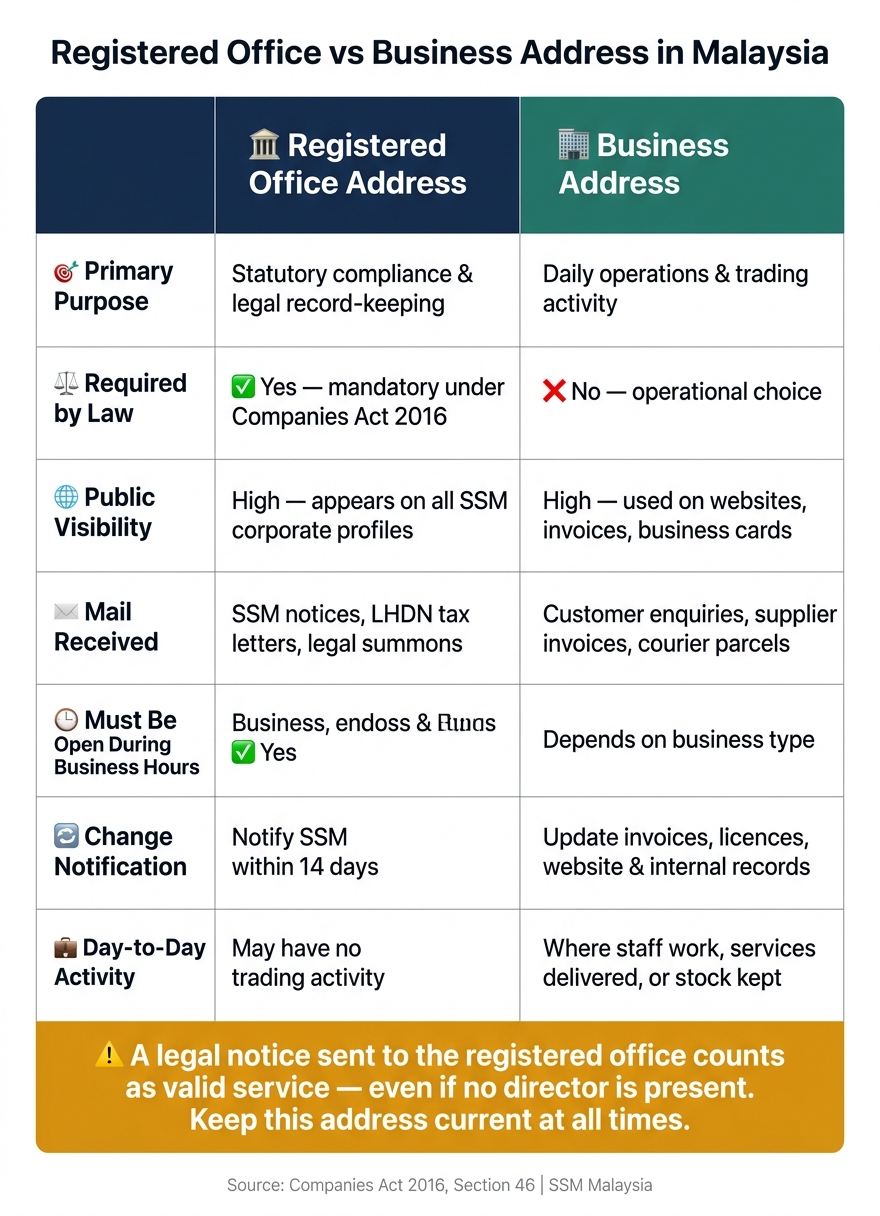
Registered Office vs Business Address in Malaysia: Key Differences
The main difference comes down to purpose: one exists for legal and filing duties, while the other is used for day-to-day business.
The easiest way to spot the gap is to look at them side by side.
Side-by-side comparison table
| Feature | Registered Office Address | Business Address |
|---|---|---|
| Primary purpose | Statutory compliance and legal record-keeping | Daily operations |
| Legal status | Mandatory statutory address | Operational address, not the statutory one |
| Public visibility | High; appears on all official SSM corporate profiles | High; used on websites, business cards, and invoices |
| Mail handling | Government letters, tax notices (LHDN), and legal summons | Customer enquiries, supplier invoices, and general parcels |
| Day-to-day use | May have no trading activity | Where staff work, services are delivered, or stock is kept |
| Update trigger | Notify SSM within 14 days | Update invoices, licences, and internal records |
What the difference means in practice
This matters because each address handles a different kind of mail, and the risk is not the same.
The big one is the registered office. If a legal notice, summons, or statutory letter is sent there, it counts as valid service on the company even if no director is physically there. So if that address is old, wrong, or simply not checked, the company could miss a deadline without even realising the document arrived.
The business address works differently. That’s usually the place customers, suppliers, and couriers expect to find. It appears on invoices, websites, and business cards. If this address is wrong, the problem is less about SSM compliance and more about confusion, missed deliveries, and a poor customer experience.
A simple example shows why this matters. If you use your home address as the registered office, that address becomes public in SSM records. On the flip side, if you use your company secretary’s address as the business address, customers or couriers may turn up at a place that doesn’t handle daily operations.
If the business moves, update each address for its own job. Notify SSM promptly when the registered office changes, and update your invoices, website, licences, and internal records when the business address changes.
Can both addresses be the same, and how should founders decide?
Now that the difference is clear, the next step is simple: can one address do both jobs? Yes, but only if that address can handle statutory mail, public access, and day-to-day business activity.
When one address works for both
Use one address for both roles only if someone can receive legal mail there during business hours and the premises are the actual base of operations.
In plain terms, the address must match what happens on the ground. If the site handles compliance matters and it’s where the business runs, one address is fine.
If the premises can’t cover both compliance and operations, split the addresses.
When separate addresses are the better choice
Separate addresses usually make more sense for home-based, remote, mobile, or often-moving businesses. This setup also helps keep a home address off public records.
That matters more than many founders think. If the address on file doesn’t match reality, you could miss notices and end up with public records that are wrong.
How to choose the right arrangement and next steps
Before deciding, run through these four checks:
- Who will receive legal correspondence?
- Is the address accessible during business hours?
- Where do actual operations take place?
- How fast can an address change be filed with SSM?
It’s best to decide this early. The registered office must be a real Malaysian address used for compliance, a key requirement during Sdn Bhd incorporation.
Summary: what founders should remember
A registered office is the legal address for statutory notices and public records. A business address shows where the company actually operates.
FAQs
Can a virtual office be used as a registered office?
Yes. In Malaysia, a virtual office can serve as a registered office as long as it is a physical address in the country and stays valid at all times.
That’s because the registered office is mainly used for official communications and statutory records. It doesn’t need to be your main place of business.
In practice, this is pretty common. Many companies use their company secretary’s address as the registered office.
What happens if I miss the 14-day SSM update deadline?
Missing the 14-day deadline to update your company details with SSM can put your business in non-compliance with the Companies Act 2016.
That can lead to penalties, late filing fees, or legal action against the company and its directors.
The fix is simple: keep your compliance records current and report statutory changes as soon as they happen.
Should I use my home address as my registered office?
Generally, no – unless your home is a valid Malaysian address that you can maintain at all times as your company’s registered office.
For a Sdn Bhd, the registered office must be a valid local address in Malaysia on a continuous basis. It also needs to match the company secretary’s details and the company’s statutory filings. Because of that, many companies use the company secretary’s address if it meets those requirements.