


Part-Time Employee Payroll in Malaysia : Introduction
A restaurant owner in Ipoh recently called our office in a panic.
“LHDN is asking for records on my weekend staff. I thought part-timers were simple — just pay cash and we’re done, right?”
Not quite.
Here’s the reality: part-time employees in Malaysia trigger the same compliance requirements as full-time employees — sometimes more, because their schedules are harder to track.
This guide clears up the most common mistakes about part-time employment payroll, covering minimum wage, working hours, rest days, public holidays, overtime pay, annual leave, sick leave, and record-keeping. For more business insights, check out our blog.
Definition of a part-time employee (Malaysia)
- A part-time employee is an employee whose average weekly working hours are more than 30% but less than 70% of the normal weekly working hours of a comparable full-time employee doing similar work in the same enterprise.
- For a 45-hour full-time week: part-time = between 13.5 hours (30%) to 31.5 hours (70%).
- “Normal hours of work” means the hours agreed in the contract of service (your employment contract / offer letter).
Misconception #1: Part-time employees can be paid below minimum wage
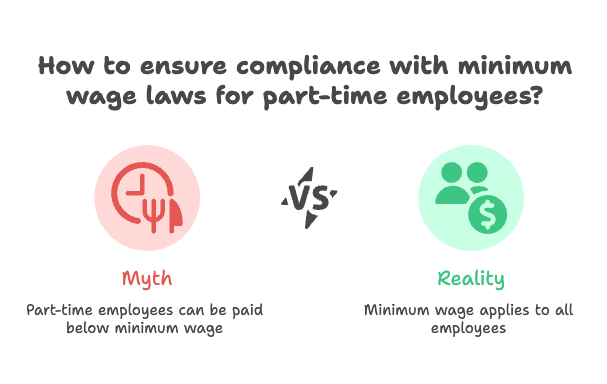
The myth: “Minimum wage is for full-time staff. My weekend helper is fine at RM6/hour.”
The reality: Minimum wage applies to all employees — whether full-time employee or part-time employee.
Under the Minimum Wages Order 2024, the minimum wage moved to RM1,700/month from 1 February 2025 for most employers. Some categories had earlier transitional windows, but don’t rely on outdated figures like RM1,500 or RM7.21/hour from previous years.
What to do:
- If you pay hourly, make sure the rate meets the current minimum wage framework
- If you pay monthly salary, check that total monthly pay ÷ actual hours worked meets the minimum
Why this matters: Minimum wage complaints can trigger Labour Department investigations and force you to pay back-wages. And once authorities start looking, they often review your entire payroll setup including working hours, overtime pay, and public holidays.
Misconception #2: Part-timers don’t need EPF/SOCSO/EIS
The myth: “They only work a few hours a week, so no statutory contributions needed.”
The reality: Part-time employment status doesn’t exempt you from statutory obligations under the Employment Act 1955.
If someone is genuinely your part-time employee (under an employment contract), assume statutory contributions apply unless you’ve confirmed an exemption. This includes Employees’ Provident Fund (EPF), Social Security Organisation (SOCSO), and Employment Insurance System (EIS).
Safe approach:
- Treat part-time staff and shift workers as employees unless the relationship clearly fits an independent contractor model
- Register them and make the required contributions
- Keep contribution records
Note: The biggest compliance mistake is assuming “part-time employment = no statutory.” Don’t make that assumption.
Misconception #3: Part-timers aren’t entitled to annual leave or sick leave
The myth: “Annual leave and paid sick leave are only for full-timers.”
The reality: Under the Employment (Part-Time Employees) Regulations 2010, part-time employees have leave protections at their ordinary rate of pay.
What this means for you:
- You need a leave system for part-time staff, even a simple one
- You need a clear method to calculate annual leave and sick leave for irregular working hours
- Part-time employees earn annual leave and paid sick leave on a pro-rated basis compared to full-time employees
Don’t skip this — it’s required under employment laws.
Misconception #4: Overtime doesn’t apply to part-time employees
The myth: “Overtime work is only for full-time staff.”
The reality: Here’s the important nuance — for part-time employees, you need to distinguish between:
- Extra hours (beyond the part-time employee’s agreed normal hours), and
- Overtime (which typically kicks in once they exceed the normal working hours of a comparable full-time employee)
Don’t automatically label every extra hour as 1.5x overtime pay. The Employment (Part-Time Employees) Regulations 2010 have specific overtime rules about this.
Payroll tip: Your payslip should clearly show:
- Normal hours (as agreed in the employment contract)
- Extra hours
- Overtime work (if applicable)
- Any public holidays or rest days premium treatment
Clear documentation prevents disputes about overtime pay.
Misconception #5: Public holiday pay is only for full-time employees
The myth: “If my part-time employee works on a public holiday, I just pay their normal rate.”
The reality: Part-time employees have public holidays entitlements under the Employment (Part-Time Employees) Regulations 2010. This includes:
- How substitution works when public holidays fall on rest days
- Your obligation to specify which paid holidays apply
Practical approach:
- If a part-time employee is entitled to that public holiday and works on it, apply the correct premium treatment under the regulations
- If public holidays fall on rest days, substitution rules may apply — document it properly
- Consider how public holidays like National Day, Federal Territory Day, and Worker’s Day affect your part-time staff scheduling
Important: Don’t assume it’s always “3x pay” — oversimplifying creates problems when the actual overtime rules are more nuanced.
Special Challenge: Rotating Schedules (The Real SME Problem)
If your roster changes every week, here’s what keeps you compliant with employment laws:
1. Put “normal hours” in writing
Your employment contract or letter should state:
- Expected weekly working hours (e.g., “up to 20 hours per week”)
- How rest days are determined
- How extra hours and overtime work are treated
- How public holidays scheduling works
Without this, “normal working days” and “normal hours” become arguments instead of facts. And you’ll lose those arguments.
2. Keep timekeeping and rosters (your audit shield)
Maintain these records:
- Rosters (what you planned)
- Attendance tracking (what actually happened)
- Payslips
- Statutory contribution proof
- Annual leave and sick leave records
These documents are your defense during an audit.
Misconception #6: You can pay cash and skip records
The myth: “Cash payment is fine — no paperwork needed.”
The reality: Cash payments aren’t illegal, but cash without payroll records is how employers fail audits.
If authorities ask questions, “I paid cash” is not evidence.
Your defense is:
- Employment contract or offer letter
- Timesheets and attendance records
- Payslips
- Proof of statutory remittances (where applicable)
Keep these for every part-time employee, every pay period.
Misconception #7: Part-time means no PCB/MTD
The myth: “They’re part-time employees, so no tax deductions needed.”
The reality: PCB (tax deductions) depends on taxable income from their monthly salary — not employment type.
The safe approach: run the official calculation method based on the part-time employee’s actual payroll information, rather than guessing based on their part-time employment status. If you’re unsure about tax calculations, LBCO’s taxation services can help ensure compliance.
Misconception #8: Contract workers and part-timers are the same thing
The myth: “I call them ‘contractors’ so I avoid EPF and annual leave obligations.”
The reality: Labels don’t decide employment status under the Employment Act 1955. The actual working relationship does.
Red flags you have a part-time employee (not a contractor):
- You control their schedule and how they work
- They’re integrated into your operations (shift patterns, uniform, supervisor)
- You provide tools and workplace
- They mainly work for you
Misclassification is one of the fastest ways to trigger backdated liability for EPF, SOCSO, annual leave, and sick leave.
The Record-Keeping Rule That Prevents 90% of Problems
Keep payroll and HR records long enough to defend yourself.
For Malaysia tax purposes, the baseline is 7 years (Income Tax Act requirement). Many employers keep payroll and HR records this long so everything matches during audits. Professional accounting services can help you maintain these records systematically.
What to keep:
- Employment contracts for all part-time employees
- Rosters and timesheets showing working hours
- Payslips
- Statutory contribution records (EPF, SOCSO, EIS)
- Annual leave and sick leave records
- Rest days and public holidays records
- Overtime work documentation
Seven years. Everything.
Quick Checklist: Part-Time Employee Payroll (2025/2026)
✓ Minimum wage: Follow current Minimum Wages Order (RM1,700/month from Feb 2025 for most employers)
✓ Employment contract: State normal hours + rest days rules + how extra hours/overtime work is handled
✓ Working hours: Be aware of 45-hour/week limit under Employment Act 1955 amendments for covered employees
✓ Public holidays: Apply Employment (Part-Time Employees) Regulations 2010 rules + substitution logic where relevant
✓ Annual leave/sick leave: Don’t ignore — build a simple pro-rating method for part-time staff
✓ Payslips: Always issue, even for hourly or cash-paid part-time employees
✓ Records: Keep rosters + timesheets + payslips + statutory proof for 7 years
✓ Rest days: Document rest days clearly in employment contracts
✓ Overtime pay: Track and calculate overtime work correctly according to overtime rules
Understanding Casual Employment vs Part-Time Employment
There’s often confusion between casual employment and part-time employment in Malaysia.
Part-time employment: Regular working hours but fewer than full-time employees. Part-time staff have fixed schedules and ongoing employment contracts with entitlements to annual leave, sick leave, rest days, and public holidays.
Casual employment: Irregular, sporadic work without guaranteed hours. Casual employees may work on-call or as needed, but still have basic protections under employment laws.
Both part-time employees and casual employees are covered under the Employment Act 1955 and must receive minimum wage, overtime pay when applicable, and proper payslips.
Part-Time Work and the Labour Market
Part-time employment is growing in Malaysia’s labour market. According to data from the Department of Statistics, the labour force increasingly includes part-time staff across retail, food service, and professional services.
Business owners hiring part-time employees need to:
- Understand how work hours affect labour costs
- Calculate overtime pay correctly
- Manage rest days and public holidays scheduling
- Provide annual leave and paid sick leave on a pro-rated basis
- Maintain part time contracts that comply with the Employment Act 1955
The labour market shift toward flexible work hours means more SMEs are managing part-time employment — and getting the compliance right is critical.
Part-Time Payroll Is Not “Lite Payroll”
It’s payroll with more edge cases.
LBCO handles part-time employee and full-time employee payroll with the same compliance discipline — minimum wage checks, roster-based calculations for working hours, public holidays treatment, overtime pay calculations, annual leave and sick leave tracking, rest days documentation, and proper record-keeping under the Employment Act 1955 and Employment (Part-Time Employees) Regulations 2010 — so you can run your business without living inside spreadsheets.
Whether you’re managing part-time staff, casual employment, or full-time contracts, our payroll outsourcing ensures compliance with employment laws while saving you time on monthly salary processing, attendance tracking, and statutory remittances.
Need help with:
- Company incorporation for your new business?
- Accounting services to manage your books?
- Tax filing and planning to stay compliant?
- Company secretarial services for SSM compliance?
Explore our services or check out our startup launch package for new businesses.
Book a free consultation to discuss your payroll needs.
Questions about your part-time employment payroll obligations? Contact LBCO for a consultation. We help Ipoh SMEs stay compliant with the Employment Act 1955, manage working hours correctly, calculate overtime pay accurately, and save time on payroll administration for both part-time employees and full-time employees.
Ready to simplify your payroll? Book a free consultation or view our pricing to get started.