

For incomplete-month pay under Section 18A, I use actual calendar days – not a fixed 26-day divisor. In Peninsular Malaysia and Labuan, the calculation is monthly wages ÷ days in the wage period × eligible days.
Here’s what I check before calculating your pay:
- Which payroll compliance laws apply: Sabah and Sarawak have separate Labour Ordinances.
- Which days count: Joining dates, final employment dates and unpaid leave affect the total. Paid rest days and public holidays count too.
- Which method fits: Calendar-day proration applies under Section 18A. Working-day calculations serve other policy or contract purposes; the 26-day divisor serves certain ordinary-rate calculations.
- What happens next: I round the gross amount to the nearest sen, then calculate EPF, SOCSO, EIS and PCB separately.
For example, 16 eligible days in October 2026 give you 16/31 of your monthly wages – RM2,580.65 on RM5,000.00.
My final check? <u>Verify payroll settings and keep the calculation records</u>, with supporting payroll and tax documents retained for at least seven years.
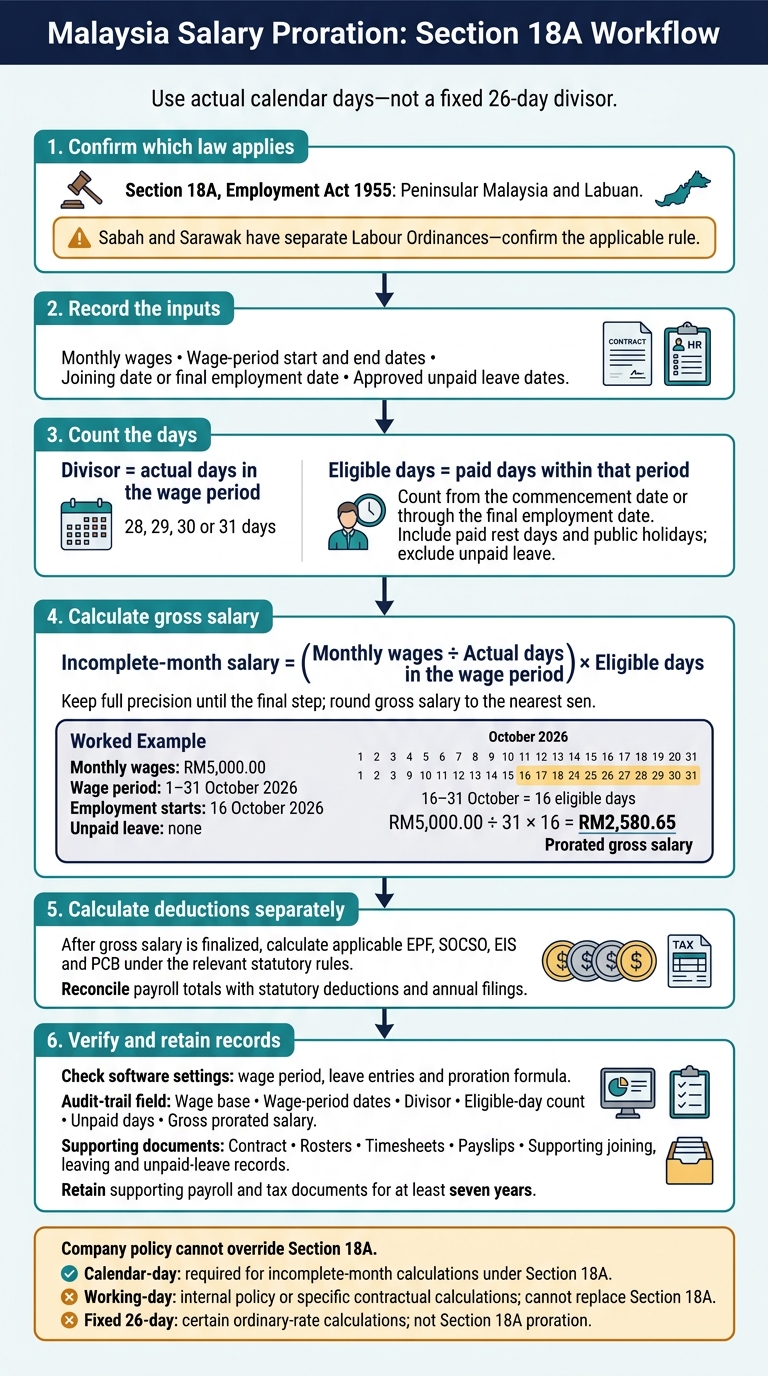
Malaysia Salary Proration: Section 18A Workflow
Section 18A: Use Actual Days in the Wage Period
Section 18A of the Employment Act 1955 sets the formula for prorating incomplete-month salary in Peninsular Malaysia and Labuan:
Salary for incomplete month = (Monthly wages ÷ Actual days in the wage period) × Eligible days.
Monthly wages means the employee’s monthly wage being prorated. The divisor is the actual number of days in the wage period, while eligible days are the paid days within that period.
Company policy cannot override Section 18A. Set payroll to use the actual days in the month, not a fixed divisor.
Count Wage-Period Days and Eligible Days
Check the wage period’s start and end dates. For new hires, count eligible days from their commencement date. For resignations, count through the final employment date. Include only paid days and exclude unpaid leave.
Calculate Gross Salary and Round to the Nearest Sen
Example: Monthly wages are RM5,000.00, the wage period is 1 October 2026 to 31 October 2026, and employment starts on 16 October 2026, with no unpaid leave. 16–31 October counts as 16 eligible days. RM5,000.00 ÷ 31 × 16 = RM2,580.65. Keep full precision until the final step, then round the gross amount to the nearest sen.
The next section compares this statutory method with common payroll methods used in practice.
sbb-itb-ba278e7
Compare Calendar-Day, Working-Day and Fixed-Day Methods
Payroll policies may list all three methods, but Section 18A governs incomplete-month wages. The table separates the statutory method from other payroll conventions.
| Method | Denominator | Days counted | Effect on incomplete-month salary | Appropriate payroll use |
|---|---|---|---|---|
| Calendar-day | Actual calendar days in the month: 28, 29, 30 or 31 | Eligible calendar days | Matches Section 18A; the daily rate changes with the month’s length | Required for incomplete-month cases under Section 18A |
| Working-day | Scheduled working days in the month | Eligible working days based on the stated schedule and holiday rules | Results depend on the roster and public-holiday rules; affects salary only where a policy or contract adopts it | Internal policy or specific contractual calculations; cannot replace Section 18A |
| Fixed 26-day | 26 | Eligible days as defined by the policy | Uses a constant divisor; affects salary only where a policy or contract adopts it | Calculates the ordinary rate of pay for certain statutory payments; does not apply to Section 18A |
Of the methods below, only the calendar-day method applies to Section 18A incomplete-month calculations. The other two serve separate payroll purposes.
Calendar-Day Method
Use the Section 18A formula for incomplete-month wages. Count eligible calendar days, including weekends and public holidays, against the actual number of calendar days in that month.
Working-Day Method
Monthly salary × (Eligible working days ÷ Scheduled working days in the month).
Set out the roster and holiday rules in writing, as the result depends on the schedule. Use this method only for internal policy or specific contractual calculations – not as a replacement for Section 18A.
Fixed 26-Day Method
Monthly salary × (Eligible days defined by the policy ÷ 26).
The policy must state which days qualify as eligible days. Use the 26-day divisor only for ordinary-rate calculations under the stated rule, not for Section 18A proration.
How to Calculate and Record Prorated Salary
Once you’ve chosen the correct proration method, record the inputs before running payroll. Check the contract and payroll records to confirm the wage base, wage-period dates and reason for the incomplete month.
Check Joining, Leaving and Unpaid-Leave Calculations
Cross-check the contractual joining date, final employment date and approved unpaid leave dates against HR records. Verify each case using the contract and approved records.
Keep Payroll Records and Check Software Settings
Keep payroll records that support the calculation and help you answer audit queries. Record the wage base, wage-period dates, unpaid days and gross prorated salary.
Retain the contract, rosters, timesheets, payslips and supporting documents used to verify joining or leaving dates and unpaid leave.
Before approving payroll, check that the software uses the correct wage period, leave entries and proration formula.
Conclusion: Apply the Correct Rule and Keep Records
Start with what triggered the calculation: joining, leaving or unpaid leave. Confirm which law applies before calculating pay. If Section 18A applies, use the actual days in the wage period and count only eligible days. Follow the method that applies to the case – not whichever calculation is easiest. Do not substitute one divisor for another.
Keep an audit trail showing the divisor, eligible-day count, and supporting payroll compliance and tax documents for at least seven years.
Calculate prorated gross salary separately from net pay. Once the gross amount is final, work out the applicable EPF, SOCSO, EIS and PCB deductions under the relevant statutory rules. Reconcile payroll totals with statutory deductions and annual filings.
FAQs
Are allowances included in my prorated salary?
Whether allowances are included in prorated pay depends on your company policy and the type of allowance. Travel or entertainment allowances count towards total remuneration for tax and reporting purposes, but payroll rules determine whether they’re included in proration. Check your employment contract or company handbook to see how allowances are handled for incomplete months.
LBCO offers payroll processing support for Malaysian SMEs dealing with complex salary structures and compliance requirements [3].
How is my salary prorated in Sabah or Sarawak?
In Sabah and Sarawak, salary proration follows your employment contract or company policy, rather than a single national formula. For an incomplete month, employers typically calculate salary using the days worked against either the actual number of days in that month or a standard 30-day month.
Consistent payroll processing helps keep these calculations accurate. LBCO provides payroll support to help Malaysian SMEs handle salary proration and meet statutory requirements.
What can I do if my salary is prorated incorrectly?
Check your employment contract and company policy to confirm which proration method applies. If you spot a discrepancy, contact HR or management promptly and ask them to review your payroll data and payslip. Payroll errors can lead to compliance issues and possible Labour Department investigations.
If the error continues, professional payroll support from LBCO can help keep salary structures, deductions and proration calculations accurate and in line with Malaysian labour laws [3][4].