


Did you know that failing to issue an accurate statement of remuneration can lead to a fine of up to RM20,000 or even six months in prison? For many business owners, the annual rush to prepare the ea form malaysia feels like a high-stakes race against the clock, complicated by confusing calculations for Benefits-in-Kind (BIK) and Value of Living Accommodation (VOLA). It’s completely natural to feel overwhelmed by the pressure of getting every figure right before the February 28 deadline.
We believe that managing your team’s taxes should be a source of professional pride, not a source of anxiety. That’s why we’ve designed this guide to help you achieve total compliance for the 2026 tax season. You’ll learn exactly how to meet LHDN requirements with ease, ensuring your employees receive accurate forms while you protect your business from unnecessary penalties. We’ll explore the critical differences between Form EA and Form E, break down the latest tax-exempt allowances, and provide the clarity you need to handle payroll with absolute confidence.
Key Takeaways
- Understand the non-negotiable February 28, 2026, deadline for distributing the ea form malaysia to your entire workforce.
- Identify which staff members require a form, including those who were employed for as little as seven days during the 2025 calendar year.
- Learn how to accurately calculate complex non-cash perks like Benefits-in-Kind (BIK) and Value of Living Accommodation (VOLA) to avoid reporting errors.
- Discover the significant financial risks of non-compliance, with potential fines ranging from RM200 to RM20,000 for each incorrect statement.
- Explore how professional payroll management and cloud-based tools can streamline your annual reporting and remove administrative stress.
What is the EA Form (Borang EA) in Malaysia?
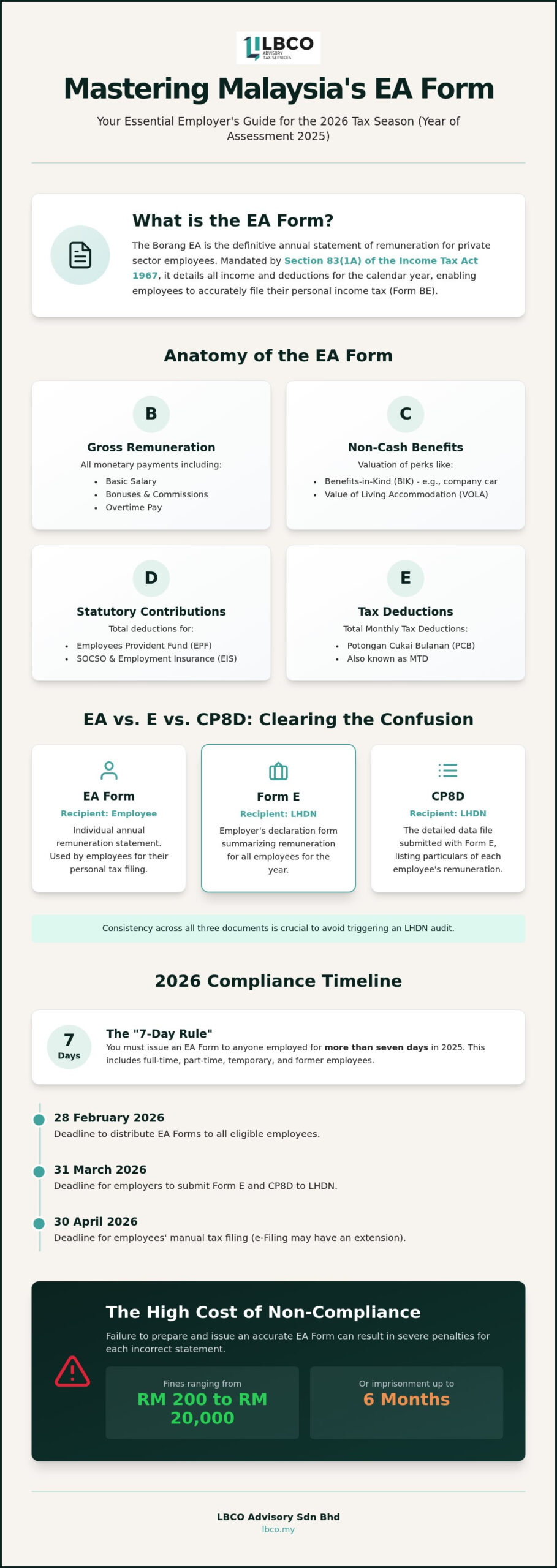
The ea form malaysia, officially known as Borang EA (C.P.8A), serves as the definitive annual statement of remuneration for private sector employees. It acts as a comprehensive record that captures every ringgit earned and every cent deducted throughout the preceding calendar year. For the 2026 tax season, this document reflects all income and statutory contributions made during the 2025 Year of Assessment. Without this form, employees would find it nearly impossible to accurately navigate the MyTax portal to file their personal tax returns, specifically Form BE.
Under the law, specifically Section 83(1A) of the Income Tax Act 1967, employers are legally mandated to prepare and distribute this statement to their staff. It isn’t just an administrative courtesy; it’s a statutory requirement designed to ensure transparency between the company, the employee, and the Inland Revenue Board of Malaysia (LHDN). By providing a clear breakdown of gross earnings and tax deductions, the form allows for seamless reconciliation between employer filings and individual tax declarations.
Key Components of the EA Form
Understanding the layout of the ea form malaysia helps both employers and employees ensure accuracy before filing begins. The document is divided into several critical sections that define your total taxable income:
- Section B: This area lists your gross remuneration. It includes your basic salary, bonuses, commissions, and any overtime pay received during the year.
- Section C: This focuses on non-cash benefits. You’ll find figures for Benefits-in-Kind (BIK), such as company cars or fuel cards, and the Value of Living Accommodation (VOLA) if your employer provides housing.
- Section D: This covers your statutory contributions. It details the total amounts paid into the Employees Provident Fund (EPF), SOCSO, and the Employment Insurance System (EIS).
- Section E: This section shows the total Monthly Tax Deductions (PCB/MTD) remitted to LHDN on your behalf, which is essential for determining if you’re owed a refund or have a balance to pay.
EA Form vs. Form E vs. CP8D: Clearing the Confusion
It’s common to feel confused by the various labels used during tax season. While the EA Form is the personal copy given to the employee for their own filing, Form E is the company’s summary declaration of its entire workforce’s remuneration. Alongside Form E, employers must submit the CP8D, which is the digital attachment containing the granular details of every single employee. Maintaining perfect consistency across these three documents is the best way to avoid the stress of an LHDN audit. Discrepancies often trigger red flags in the tax office’s automated systems, so double checking these figures is a proactive step toward peace of mind. For a side-by-side view of all three forms, their recipients and deadlines, see our guide to Form EA, Form E and Form CP8D.
Employer Obligations and Deadlines for 2026
Meeting your statutory duties as an employer requires more than just filling out a form; it’s about precision and timing. Every employer in Malaysia must prepare and distribute the ea form malaysia to their employees by 28 February 2026. This deadline is non-negotiable. Missing it doesn’t just create friction with your team. It invites direct scrutiny from LHDN and potential penalties that could have been easily avoided with proactive planning.
Confusion often arises regarding who exactly qualifies for a form. LHDN guidelines are clear: any individual employed for more than seven days during the 2025 calendar year must receive an EA Form. This “7-Day Rule” means your responsibilities extend far beyond your current full-time staff. You must also account for part-time workers, temporary employees, and even expatriates or foreign workers on your Malaysian payroll. If they were under your employment for at least a week, you’re legally obligated to provide their remuneration summary.
The 2026 Compliance Timeline
Keeping track of specific dates is the first step toward a stress-free tax season. Mark these critical milestones in your business calendar to stay ahead of the curve:
- 25 February 2026 (encouraged): Upload your e-CP8D remuneration data via e-Data Praisi so employees’ returns are prefilled when e-Filing opens on 1 March.
- 28 February 2026: The absolute deadline to issue the ea form malaysia to every eligible employee, including those who left the company during 2025.
- 31 March 2026: The closing date for submitting Form E and the CP8D attachment to LHDN.
- 30 April 2026: The standard deadline for individual employees to complete their manual tax filing, though e-filing typically offers a small grace period.
For a deeper understanding of how these dates fit into the broader statutory landscape, the PwC Malaysian Tax Booklet offers an excellent overview of current employment income regulations.
Handling Resigned Employees
Managing staff who left your company during the year is one of the most common logistical hurdles for SMEs. You’re still responsible for their EA Forms, even if they resigned months ago or were terminated. It’s vital to maintain updated contact details for all former employees to ensure they receive their documents on time. If you find these administrative tasks are pulling you away from your primary passions, exploring payroll management can help automate these distributions and ensure you never miss a compliance window. Many modern businesses now use digital distribution via encrypted email to reach former staff, as you’re legally required to provide copies upon request to assist with their personal tax declarations.
Deep Dive: Decoding BIK, VOLA, and Tax-Exempt Allowances
Calculating the value of non-cash perks is often where the most significant errors occur on the ea form malaysia. Benefits-in-Kind (BIK) refer to assets or services provided by the employer for the employee’s personal use. Even though no physical cash is exchanged, these benefits are considered taxable income and must be reported with precision. Properly documenting these perks on the ea form malaysia ensures your team stays compliant while benefiting from the incentives you provide.
Value of Living Accommodation (VOLA) follows a specific logic that often trips up even seasoned administrators. Generally, the taxable value is the lower of 30% of the employee’s gross income or the defined value of the property provided. For those provided with hotel accommodation, the value is simplified to just 3% of their gross income. Using LHDN-approved formulas is the only way to ensure you don’t inadvertently under-report income and trigger a compliance review for your staff.
Calculating Benefits-in-Kind (BIK)
Employers can choose between the Formula Method and the Prescribed Value Method to determine BIK values. The Prescribed Value Method is frequently preferred by SMEs for its simplicity and lack of friction. For instance, a company car costing up to RM50,000 carries a prescribed annual benefit value of RM1,200. Similarly, semi-furnished units featuring lounge, dining, or bedroom furniture are valued at a flat RM840 per year. It’s vital to remember that BIK is taxable even if no cash changes hands, as it represents a tangible economic advantage for the employee. Other common items include mobile phones, where the benefit is limited to one unit per category, and the cost of drivers or household servants.
Common Tax-Exempt Allowances in Malaysia
Section F of the form is reserved for identifying and reporting tax-exempt allowances correctly. While these amounts don’t add to the employee’s tax bill, they must be documented for transparency and audit purposes. We see many businesses overlook these limits, which can lead to unnecessary confusion during tax season. Key exemptions for 2026 include:
- Petrol and Travelling: Exempt up to RM6,000 annually if used for official duties.
- Childcare Allowance: Offers significant relief with an exemption limit of RM3,000 per year.
- Medical Benefits: Generally fully exempt when provided to employees, their spouses, and children.
- Parking and Meal Allowances: These remain in Section F as long as they are reasonable and provided based on actual duties performed.
If you find these calculations are becoming a hurdle, our payroll management services can help you automate the reporting of these complex benefits, allowing you to focus on your primary passions while we handle the meticulous details.
Consequences of Non-Compliance and Common Errors
Ignoring the finer details of the ea form malaysia can lead to significant legal and financial repercussions that no business owner should have to face. Under Section 120 of the Income Tax Act 1967, failing to prepare or provide this statement is a serious offence. You could face fines ranging from RM200 to RM20,000 for each missing or incorrect form. In severe cases of repeated negligence, the law even allows for imprisonment for up to six months. These aren’t just empty threats; LHDN has significantly increased its scrutiny of payroll records to ensure every ringgit is accounted for correctly.
The stress of an unexpected tax bill or a legal summons can be avoided through meticulous record-keeping. We’ve seen how even small oversights in January can snowball into major compliance hurdles by March. Protecting your company’s reputation and your employees’ peace of mind starts with understanding where most mistakes happen and taking proactive steps to prevent them.
Top EA Form Mistakes to Avoid
Most errors aren’t intentional but stem from a misunderstanding of how specific figures should be reported. To protect your business, keep a close eye on these common pitfalls:
- Mixing Contribution Portions: Only the employee’s portion of EPF, SOCSO, and EIS should appear on the form. Including the employer’s statutory contributions is a frequent error that inflates the reported figures incorrectly.
- PCB Mismatches: Ensure the total Monthly Tax Deductions (PCB) shown on the annual statement matches the exact sum of the twelve monthly payments made to LHDN throughout the year.
- Mislabeling Allowances: Confusing taxable perks with tax-exempt ones can lead to under-reporting. This is a major red flag for tax officers during their review process.
How Discrepancies Trigger Audits
LHDN utilizes a sophisticated automated matching system that cross-references your company’s Form E and CP8D with the individual tax filings of your employees. When the numbers don’t align, it often triggers a “Section 83” audit. These audits can be intrusive and time-consuming, pulling your focus away from your primary passions and business growth. Performing a thorough payroll reconciliation in January is the most effective way to prevent February stress. By verifying your data early, you ensure that the ea form malaysia you issue is a perfect reflection of your statutory records. If you want to eliminate the risk of human error entirely, our payroll management services provide the meticulous oversight needed to keep your compliance record spotless.
How LBCO Advisory Simplifies Your Payroll Compliance
Managing a successful SME requires your full attention on growth and innovation, yet the annual tax cycle often pulls you back into a world of complex spreadsheets and statutory deadlines. At LBCO Advisory, we act as the path-clearer for your business, removing the administrative friction that accompanies the ea form malaysia season. By integrating our cloud-based bookkeeping with expert payroll management, we ensure that every figure is reconciled long before the February deadline, giving you the peace of mind you deserve.
Our approach goes beyond simple data entry. We provide a proactive partnership that identifies specific opportunities for corporate tax planning while ensuring you remain 100% compliant with LHDN regulations. By synchronizing your payroll data with your broader financial records, we eliminate the discrepancies that often trigger audits. With our steady hands managing your back-office functions, you can transition from the stress of manual reporting to a streamlined, digital-first operation that supports your long-term success.
Seamless Payroll and Statutory Management
Precision is the foundation of everything we do. Our automated systems handle the intricate, real-time calculations for EPF, SOCSO, and EIS, ensuring that the statutory deductions reported on each ea form malaysia are error-free. We take full responsibility for the timely issuance of these forms to your staff, as well as the accurate submission of Form E and CP8D to LHDN. For businesses with more complex needs, such as managing expatriate payroll, handling foreign worker EPF contributions, and processing tax clearances, our team provides the specialized expertise required to handle these high-stakes requirements without delay.
Your Strategic Partner in Northern Malaysia
Since 1971, local SMEs in Ipoh, Penang, and Kampar have trusted us to safeguard their compliance and financial health. We understand the specific challenges faced by businesses in Northern Malaysia, and we’re committed to helping you move away from dusty, manual processes toward a more dynamic, cloud-integrated future. Our goal is to celebrate your growth as if it were our own, providing the encouraging mentorship and technical mastery you need to thrive in a competitive market. Contact LBCO Advisory today to simplify your 2026 tax season and discover how a strategic partnership can transform your administrative burden into a streamlined advantage.
Secure Your Compliance and Reclaim Your Time
Mastering the 2026 tax season starts with recognizing that the ea form malaysia is more than just a piece of paper; it’s a vital bridge of trust between you and your team. By ensuring every benefit-in-kind is calculated accurately and every statutory deduction matches LHDN records, you protect your business from costly penalties while supporting your employees’ financial well-being. Proactive reconciliation in January isn’t just about avoiding audits; it’s about building a foundation of operational excellence that allows you to focus on your primary passions. You don’t have to carry this administrative burden alone.
Since 1971, we’ve helped SMEs across Ipoh, Penang, and Kampar navigate these complexities with precision and care. Our cloud-based solutions provide real-time visibility, turning a once-daunting chore into a streamlined, effortless process. Let us handle the meticulous details so you can lead your company with total confidence and clarity.
Simplify your payroll and ensure EA Form compliance with LBCO Advisory. We’re here to be your strategic partner, ensuring your business remains resilient, compliant, and ready for the future.
Common Questions About the EA Form
What is the deadline for employers to issue the EA Form in 2026?
Employers must provide the ea form malaysia to every eligible employee by 28 February 2026. This is a statutory deadline that ensures your team has sufficient time to reconcile their earnings before the individual tax filing season begins in March. Missing this date can result in significant fines, so it’s best to start your reconciliation process early in January.
Do I need to issue an EA Form for an employee who worked for only one month?
Yes, you’re required to issue the form for any staff member employed for more than seven days during the year. This “7-Day Rule” applies regardless of whether the individual was a full-time, part-time, or temporary worker. Even if they only worked for a single month in 2025, they must receive a summary of their earnings and statutory deductions.
Can an employee file their taxes without an EA Form?
While some data might be pre-filled in the MyTax portal, filing without the actual EA Form is highly discouraged. The form acts as the official source of truth for your total remuneration and Monthly Tax Deductions (PCB). Relying on it ensures that the figures you submit in your Form BE are accurate, helping you avoid discrepancies that could trigger an LHDN audit.
What is the difference between Section B and Section F on the EA Form?
Section B is for reporting your gross taxable remuneration, which includes your salary, bonuses, and overtime pay. Section F is reserved for tax-exempt allowances, such as petrol, travelling, or childcare benefits. It’s crucial to separate these correctly because items in Section F don’t add to your taxable income, whereas everything in Section B does.
Are bonuses and commissions included in the EA Form?
Yes, all bonuses, commissions, and incentives paid out during the 2025 calendar year must be included. You should report these figures in Section B under gross remuneration. These amounts are taxable in the year they are received, so even a performance bonus for 2024 that was paid in January 2025 must be captured on the 2026 form.
What should an employer do if they discover an error after issuing the EA Form?
You should issue an amended ea form malaysia to the employee immediately once an error is identified. Make sure the new form is clearly marked as a correction to avoid confusion. If you’ve already submitted the company’s Form E or CP8D to LHDN, you’ll also need to notify the tax office and submit the corrected data to maintain consistent records.
Is it mandatory to provide a physical copy of the EA Form?
No, providing a physical paper copy isn’t a legal requirement. Digital distribution via secure email or an internal HR portal is perfectly acceptable and often preferred for its efficiency. As long as the employee can easily access, download, and print the document for their personal records, your digital delivery meets all statutory obligations.
Does the EA Form include the employer’s EPF contribution?
No, the form should only reflect the employee’s portion of EPF, SOCSO, and EIS contributions. Including the employer’s share is a frequent mistake that can lead to incorrect tax calculations for your staff. The purpose of this section is to document the statutory amounts that were actually deducted from the employee’s gross salary throughout the year.
Does the EA Form need to be submitted to LHDN?
No. The EA Form is issued directly to each employee, not submitted to LHDN. What goes to LHDN is Form E (via e-Filing by 31 March) together with the employee-by-employee CP8D data (via e-Data Praisi, ideally by 25 February for prefill). All three must agree with each other.
What is the difference between the EA Form and CP8D?
The EA Form goes to your employee; CP8D goes to LHDN. The EA Form is each employee’s individual remuneration statement, while CP8D is the payroll data file covering every employee that you upload to MyTax. They carry the same underlying figures, and both must reconcile to your Form E.