
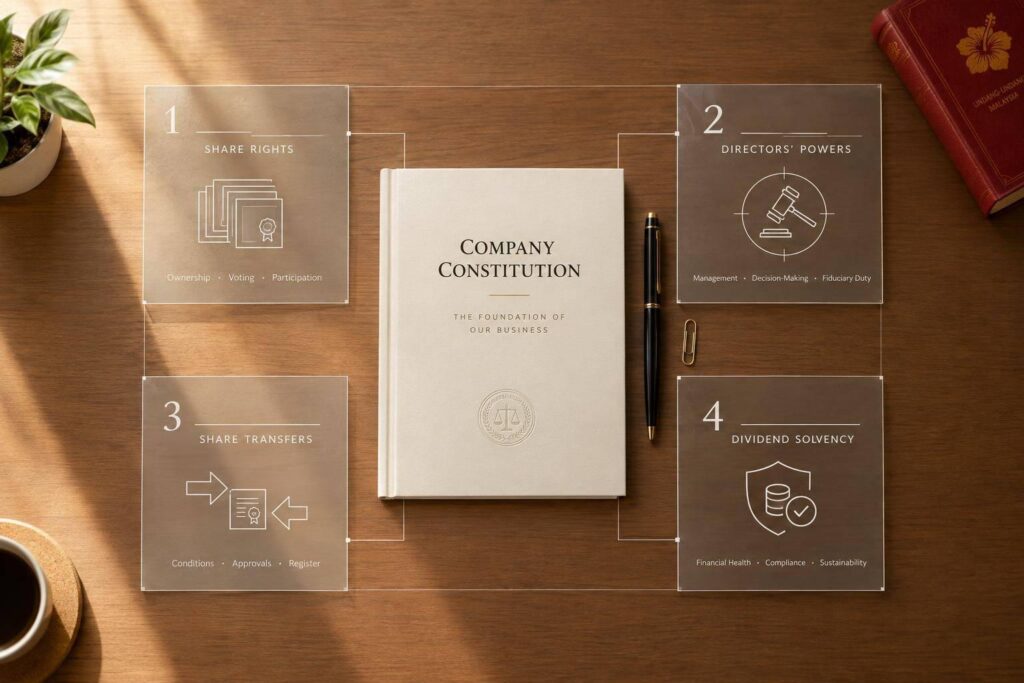

I recommend checking five areas in your company constitution: share rights, directors’ powers, meeting rules, share transfers and dividends. Check who can approve each decision before issuing shares, registering a transfer or paying a dividend.
A Malaysian Sdn Bhd can operate without a constitution, but a company limited by guarantee must have one. Where a constitution is adopted, it must work within the Companies Act 2016.
Here’s what I would check:
- Shares: State each class’s voting, dividend and capital repayment rights.
- Decisions: Separate board powers from matters requiring member approval.
- Meetings: Set notice, quorum and voting rules. Special resolutions require at least 75% approval.
- Transfers: Check restrictions, consents, registration steps and record updates.
- Dividends: Confirm profits are available and the company will remain solvent after payment.
My final check: <u>keep the constitution, approvals, company records and required SSM lodgements in line</u> whenever changes are made.
Can a Private Company Remove a Director Without 28 Days’ Special Notice
sbb-itb-ba278e7
Share Classes and Ownership Rights
Share clauses set out the financial rights and control attached to ownership. They distinguish voting and class consent rights from rights to dividends and capital repayment. If a company has more than one share class, its constitution must clearly state each class’s rights and voting power. Precise class terms matter.
Ordinary and Preference Shares
| Matter | Ordinary shares | Preference shares |
|---|---|---|
| Voting rights | Carry general voting rights, subject to the constitution and applicable law. | Do not necessarily carry full voting rights; specify the rights attached to the class. |
| Dividend entitlement | Participate in declared dividends after preferential entitlements. | May receive fixed or preferential dividends; state whether these are cumulative or non-cumulative. |
| Repayment of capital | Rank after creditors and any preferential capital entitlements on winding up. | Specify repayment rights and ranking against other classes. |
| Surplus assets | Participate in remaining surplus assets according to class terms. | May be limited to a specified amount; further participation requires express constitutional provision. |
The table outlines the commercial differences, but preference-share clauses must also meet statutory requirements. Before a company allots preference shares or converts existing shares into preference shares, section 90(4) requires the constitution to state dividend rights, voting rights, capital repayment rights, rights to surplus assets and profits, cumulative or non-cumulative status, and capital and dividend priority. Include any applicable redemption and conversion terms, along with required member and class approvals.
A class label does not define rights. An investment term sheet alone does not meet these constitutional requirements.
Dividend Priority and Class Rights
Set out the dividend rate, whether unpaid amounts accumulate, and the conditions for payment. Cumulative dividends carry unpaid entitlements forward under the class terms. Non-cumulative dividends do not automatically accumulate when undeclared. Specify each class’s priority and whether holders can participate beyond their stated entitlement. These rights do not guarantee payment: dividends must come from profits, and the company must remain solvent after payment.
Class clauses should also identify matters that need separate consent, including changes to ranking, conversion or redemption rights. Follow the constitution’s procedure for varying class rights. If it provides no procedure, consent from the affected class under section 91 may be required. A general shareholder vote does not replace required class consent.
To put these clauses into effect:
- Check that each class’s rights match across the constitution, register of members, share certificates, allotment documents and investment documents. Review voting power, dividend entitlement, capital ranking, transfer limits, and conversion or redemption terms.
- Complete the relevant records and SSM lodgements within the applicable statutory deadlines.
The constitution should then link these share rights to clear rules on who can decide company matters.
Directors’ Powers and Company Decisions
Once share rights are set, the constitution must explain who makes company decisions and how approvals are obtained. Directors run the company; members decide matters reserved by law or the constitution. These rules must not override statutory duties under the Companies Act 2016.
The constitution should then set out the procedures for board decisions and member voting.
Director Appointments, Powers and Conflicts
Set clear rules for appointing and removing directors. Define their management powers, limits on delegation, and procedures for disclosing interests and handling conflicts. These clauses should match the company’s approval limits and statutory duties.
| Decision | Common matters | Required approval |
|---|---|---|
| Board | Opening bank accounts, appointing a company secretary, signing high-value contracts and share allotments | Board resolution at a meeting or by DCR |
| Members | Amending the constitution, removing a director or auditor and approving major capital restructuring | Ordinary or special resolution, using the required meeting procedure |
| Statutory duties | Annual returns, financial statements, minutes and conflict disclosures | Compliance with statutory duties |
Board Meetings and Written Resolutions
Spell out the notice requirements, quorum, voting rules and chairperson’s role, including whether the chairperson has a casting vote. Quorum and voting rules must match the constitution and the Act – one default rule will not suit every company.
A directors’ circular resolution (DCR) requires unanimous consent by default. State any different threshold allowed by the constitution.
Member decisions have separate approval thresholds.
Member Meetings and Voting Rules
Set out how member meetings are called, the notice required, the quorum and the voting thresholds.
| Member resolution | Approval threshold | Common uses |
|---|---|---|
| Ordinary resolution | More than 50% approval | Routine shareholder decisions, including appointing auditors |
| Special resolution | At least 75% approval | Major changes, including amendments to the constitution |
These governance rules should match the share transfer and dividend clauses that follow.
Share Transfers and Dividend Payments
Malaysian Company Share Transfer Process
Share Transfer Rules and Registration
Once share rights are defined, the constitution should set out how shares can be transferred and who can approve a transfer.
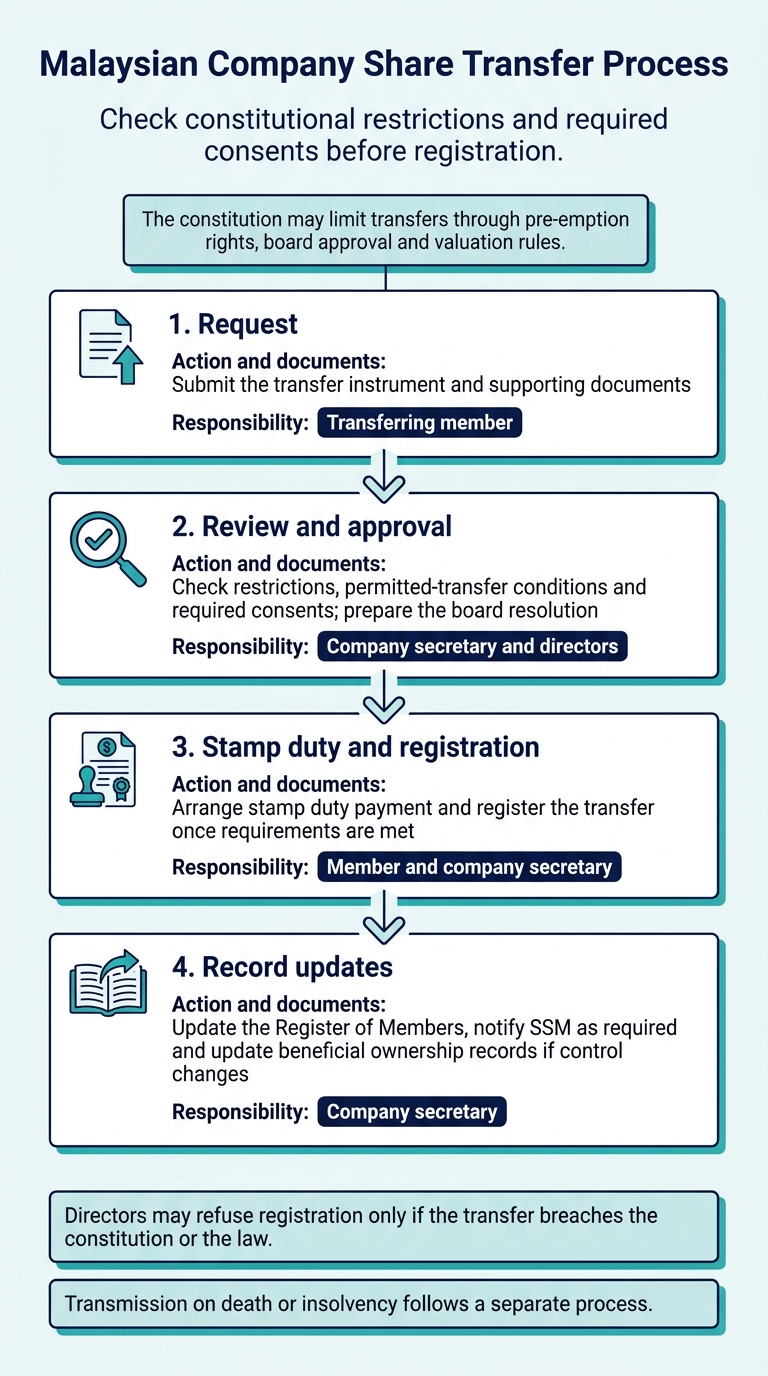
It may limit transfers through pre-emption rights, board approval and valuation rules. Directors may refuse registration only if the transfer breaches the constitution or the law. Transmission on death or insolvency follows a separate process.
Follow these steps to keep transfers valid and records consistent.
| Stage | Action and documents | Responsibility |
|---|---|---|
| Request | Submit the transfer instrument and supporting documents | Transferring member |
| Review and approval | Check restrictions, permitted-transfer conditions and required consents; prepare the board resolution | Company secretary and directors |
| Stamp duty and registration | Arrange stamp duty payment and register the transfer once requirements are met | Member and company secretary |
| Record updates | Update the Register of Members, notify SSM as required and update beneficial ownership records if control changes | Company secretary |
The constitution should also set out when value can be returned to members through dividends.
Dividend Entitlements and Solvency Rules
The constitution should explain how and when dividends are declared and paid.
Directors may approve a dividend only if the company remains solvent immediately after payment. Record the approval before paying the dividend. If the solvency test fails, do not proceed with payment.
Constitution Updates and Final Checks
Amendment Approval and SSM Lodgement
Once the key clauses are settled, keep the constitution in line with approved changes, filings and ownership changes.
Obtain the required approval before amending the constitution. Record the final wording in the company records and prepare it for the required SSM lodgement.
Final Checklist and Compliance Support
Before approving or updating the document, work through this checklist:
- [ ] Check that approved amendments are properly recorded.
- [ ] Update the constitution with the final wording.
- [ ] Check that the amended constitution still matches the company’s share, governance, transfer and dividend rules.
- [ ] Keep the approved version and resolutions on file.
- [ ] Review the constitution after any ownership change or change in company law.
For company secretary compliance support, LBCO can assist.
FAQs
What rules apply if my Sdn Bhd has no constitution?
A company constitution is optional under the Companies Act 2016. Your Sdn Bhd does not breach the regulations by operating without one. The Act’s default rules and provisions apply instead.
For many SMEs, these rules provide a sufficient legal baseline, but they are general in scope. Speak to your company secretary about how they apply to your company’s governance, voting and decision-making needs.
What if my constitution conflicts with a shareholders’ agreement?
If your company constitution conflicts with a shareholders’ agreement, read both documents together. Neither document can override mandatory requirements under the Companies Act 2016.
The documents serve different legal purposes. Before taking action, consult a qualified company secretary or lawyer to check how they interact and confirm the correct approval procedures.
Can I challenge a refusal to register my share transfer?
Yes, but your options depend on your company’s constitution and any shareholders’ agreement. Check these documents for restrictions, pre-emption rights or consent requirements that may give grounds for refusing a share transfer. Any transfer must comply with the constitution and applicable law.
If a dispute arises, consult a company secretary or lawyer to confirm the correct procedures before taking further action.