


Most SME tax trouble starts with small misses, not big fraud. If you run a Malaysian business, the main risks are simple: late filing, low CP204 estimates, weak records, wrong expense claims, payroll mistakes, and missed SST duties.
Here’s the short version of what I’d want to know first:
- Form C is due 7 months after your FYE, not by 31 December
- CP204 set too low can trigger a 10% surcharge on part of the shortfall
- Tax records must usually be kept for 7 years
- Personal spending in business accounts can lead to disallowed claims
- Wrong treatment of capital items, entertainment, drawings, and fines can push tax up
- PCB must be remitted by the 15th of the following month
- SST registration depends on rolling 12-month turnover, not just year-end sales
- Missed capital allowances and incentives can mean paying more tax than needed
- Weak bookkeeping systems often cause several tax problems at once
The bottom line: if you track deadlines, review figures every quarter, keep clean records, and fix issues early, you cut the risk of penalties, backdated tax, and cash flow strain.
Quick Comparison
| Mistake area | What goes wrong | Main impact |
|---|---|---|
| Form C / deadlines | Late filing or missed instalments | Fines, surcharge, admin stress |
| CP204 | Estimate too low | Top-up tax bill, 10% surcharge |
| Record-keeping | Missing invoices or support | Claims denied, audit trouble |
| Personal vs business | Mixed spending | Add-backs, harder to defend claims |
| Deductible expenses | Wrong claims | Higher tax, penalties |
| Capital vs revenue | Assets expensed wrongly | Wrong tax computation |
| PCB / payroll | Wrong deduction or late remittance | Fines, back-pay issues |
| SST | Late registration or filing | Penalties, backdated tax |
| Incentives / CA | Reliefs not claimed | Higher tax payable |
| Systems / support | Poor processes | Repeat errors across the board |
If you want to stay out of trouble with LHDN and keep cash flow steadier, these are the 10 areas I’d check first.
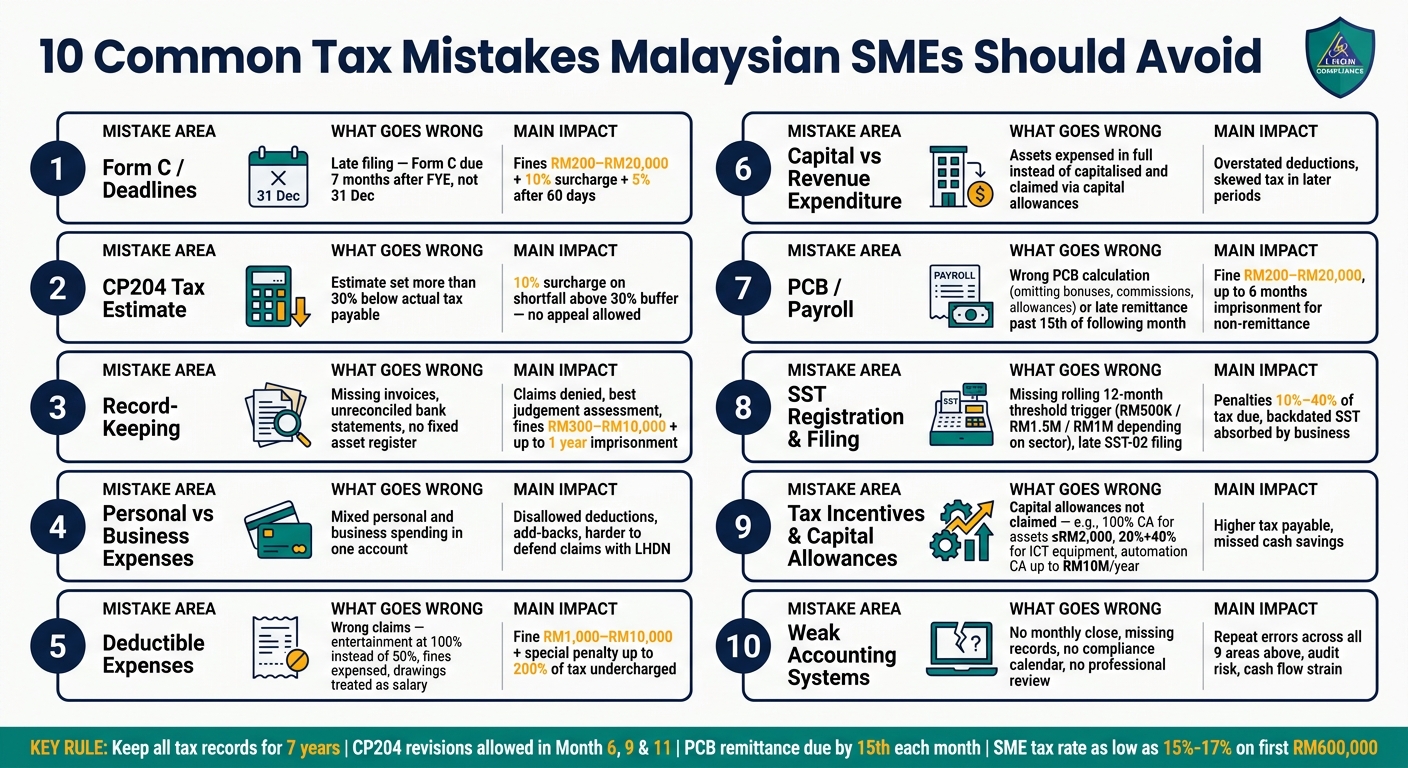
10 Common Tax Mistakes Malaysian SMEs Should Avoid: Quick Reference Guide
Why Tax Compliance Matters for Malaysian SMEs
Malaysian SMEs usually juggle several tax duties at the same time – Form C, CP204, PCB, and SST. That means one missed deadline or one filing mistake can snowball fast. And that’s exactly where the next 10 mistakes start to hurt.
Missing Form C can lead to a fine of RM200 to RM20,000 under Section 112(1) of the Income Tax Act 1967. If payment is late, there’s also a 10% surcharge, plus another 5% after 60 days. With CP204, underestimating the tax payable brings an automatic 10% surcharge on the shortfall under Section 107C(10), with no avenue for appeal.
For many SMEs, that’s not just a tax issue on paper. Underestimating CP204 can turn into a lump-sum bill that hits working capital at the worst time. A backdated SST assessment can be even more painful because the business may have to pay tax it never collected in the first place. Cash flow can tighten overnight.
There’s also the business side of it. Banks look closely at tax compliance when reviewing loan applications, overdrafts, and trade facilities. Some government tenders and corporate procurement exercises ask for proof of on-time filings or an up-to-date tax clearance. If PCB, CP204, or SST problems keep coming up, management ends up spending time fixing tax matters instead of running the business.
Good compliance does more than help you avoid fines. It also helps protect access to lower SME tax rates – as low as 15% to 17% on the first RM600,000 of chargeable income – and it supports trust with lenders and business partners. With that in mind, the next sections look at the 10 mistakes that tend to cause the biggest headaches.
sbb-itb-ba278e7
1. Missing Form C and Other Key Tax Deadlines
The most common mistake is still the most basic one: missing the filing date.
Form C is the corporate income tax return that Malaysian companies, including most Sdn Bhd SMEs, must send to LHDN to report annual taxable profits and tax payable. The key point here is simple: Form C is due 7 months after FYE, not by the calendar year.
Here’s a clear example. If your FYE is 31 December 2025, your Form C deadline is 31 July 2026. Miss that date, and penalties under the Income Tax Act 1967 can range from RM200 to RM20,000.
That’s not the only date to watch. Deadline control also needs to cover annual filing and monthly instalments. Companies must submit their CP204 tax estimate no later than 30 days before the basis period begins, and monthly instalments are due by the 15th of each month. If an instalment is missed, a 10% penalty applies to the unpaid amount.
This is where things can snowball. When CP204 is set too low and Form C is filed late, the business often gets hit with a bigger cash outflow than expected, highlighting the need for proactive tax compliance. And that usually happens at the worst possible time, when working capital is already tight.
In many SMEs, missed deadlines don’t happen because the rules are hard. They happen because calendar control is weak. Some teams have no central tax calendar. Some depend on last-minute reminders. Others take too long to close accounts after FYE.
A few basic habits can help:
- Use a central tax calendar
- Assign one person to own each deadline
- Close accounts within 2 to 3 months after FYE
- Work out the Form C deadline as soon as FYE closes
- Set reminders 60, 30, and 7 days before the due date
- Aim to file at least one month before the statutory deadline
Waiting until the final stretch of the e-Filing window is asking for trouble. A small delay can turn into penalties, cash strain, and a lot of avoidable stress.
If deadlines are already slipping, record-keeping is usually the next weak spot.
2. Underestimating CP204 Tax Estimates
Once you’ve got deadlines under control, the next risk is setting your tax estimate too low.
CP204 is the tax estimate that companies and LLPs submit to LHDN for each year of assessment. The amount is then paid in monthly instalments. In simple terms, it’s your business’s tax estimate for the year, and LHDN expects it to be reasonably close to the actual tax due.
Trouble starts when SMEs use CP204 as a way to ease short-term cash flow. Yes, a lower estimate means smaller monthly instalments. But that breathing room can come back to bite later. When the final tax is assessed, the business may suddenly face a big balance payable. That’s the main issue here: a low CP204 estimate can turn into a nasty cash shock later on.
It gets more painful if the gap is too wide. If the CP204 estimate is more than 30% below the actual tax payable, LHDN imposes a 10% surcharge on the shortfall above that 30% gap.
| Scenario | Amount (RM) |
|---|---|
| Actual tax payable (AT) | 100,000 |
| CP204 estimate (ET) | 50,000 |
| Difference | 50,000 |
| 30% buffer (30% × AT) | 30,000 |
| Excess above buffer | 20,000 |
| 10% surcharge | 2,000 |
That surcharge is charged on top of the unpaid tax. And if any monthly instalment was missed along the way, a separate 10% late payment penalty applies to each unpaid instalment. One gap can snowball into a much bigger bill.
In most cases, SMEs don’t understate CP204 on purpose. More often, it happens because they reuse last year’s tax figure without adjusting for growth, win a large contract halfway through the year, or sell an asset that pushes actual tax far above the first estimate.
The fix is pretty straightforward: review your CP204 against actual results at least once every quarter. LHDN allows revisions through Form CP204A in the 6th, 9th, and 11th months of the financial year. If your management accounts show profits coming in above your original estimate, file a revised CP204A before the gap goes beyond the 30% threshold. Doing this earlier helps keep monthly payments closer to the actual tax due and lowers the risk of a surcharge.
3. Poor Record-Keeping and Missing Supporting Documents
After deadlines and estimates are in place, the next problem is simple: can you prove your numbers?
Under Section 82 of the Income Tax Act 1967, SMEs must keep enough records for at least 7 years from the end of the relevant year of assessment. That covers documents like invoices, receipts, bank statements, payroll records, and tax working papers.
If those documents are missing, things can go wrong fast. LHDN may disallow claims, which can push up taxable income and increase tax payable. In some cases, LHDN can issue a best judgement assessment under Section 91 based on whatever information is available. On top of that, failing to keep proper records is itself an offence under Section 119A, with fines ranging from RM300 to RM10,000 and/or imprisonment of up to 1 year.
In day-to-day practice, weak record-keeping often looks like this:
- Missing invoices
- Unreconciled bank statements
- Unexplained journal entries
- No fixed asset register
The good news is that LHDN does accept electronic records, as long as they are complete, readable, and can be retrieved when requested. A neat filing system helps a lot here. Group records by year of assessment, month, and document type, and keep backups for at least 7 years. It also helps to use a monthly checklist covering bank statements, reconciliations, sales and purchase listings, payroll reports, and EPF/SOCSO/PCB proof documents. Bank accounts should be reconciled every month before the month-end close.
When records are in order, the next part of tax work becomes much less messy: classifying expenses the right way.
4. Mixing Personal and Business Expenses
Your records can look neat on paper and still cause tax compliance issues if personal and business spending sit in the same pot. That happens a lot with Malaysian SME owners who run both through one bank account.
Under the Income Tax Act 1967, only expenses incurred wholly and exclusively to earn income are deductible. Once personal spending appears in the business accounts, it becomes much harder to prove that an expense passes that test. LHDN’s guidance is clear: keep personal accounts and business current accounts separate. Domestic or personal expenses – such as family meals, personal insurance, home utility bills, or a personal trip claimed as business travel – are non-claimable and must be added back if claimed. For mixed-use items like phones, vehicles, or home internet, claim only the business-use portion. The rest should be treated as non-deductible or as a benefit-in-kind.
A few red flags tend to show up again and again. One is paying personal credit card bills from the business account. Another is seeing frequent entries like "director’s loan account" in the ledger. These don’t always mean something is wrong, but they do make the accounts harder to defend if LHDN asks questions.
The fix is simple: use a separate business account. It makes business costs easier to trace, claim, and defend, which lowers the risk of claims being challenged by LHDN. Pay yourself a fixed salary or drawings from the business account, then use your personal account for household spending. If you pay a real business expense with personal funds, record it properly as a director’s loan or capital injection, and keep the proof. That way, the deduction stays in place and the amount owed back to you is tracked correctly.
| Type of Expense | Tax Treatment | Examples |
|---|---|---|
| Clearly business | Generally deductible if wholly and exclusively to earn income. | Staff salaries, business rent, advertising |
| Clearly personal | Must be added back if claimed. | Family holidays, personal clothing, groceries |
| Mixed-use | Claim only the business portion; disallow the rest or treat as benefit-in-kind. | Phone, vehicle, home internet |
When you keep that line clear, deductions are easier to support, tax adjustments are less likely to hit, and cash flow is less likely to get thrown off.
5. Claiming Incorrect Deductible Expenses
Having a separate business account helps, but it doesn’t mean every outgoing amount is tax-deductible.
LHDN applies a simple test: an expense is deductible only if it is wholly and exclusively incurred to earn business income. If it doesn’t pass that test, you need to add it back in the tax computation. This is also the time to see if you can maximize tax incentives to offset these costs. And that can get costly. Under Section 113(1) of the Income Tax Act 1967, an incorrect return can lead to a fine of RM1,000 to RM10,000, plus a special penalty of up to 200% of the tax undercharged.
The usual problem areas are entertainment, capital items, owner drawings, and fines. These are the ones that most often push taxable profit up when they’re handled the wrong way.
| Expense Type | Correct Treatment | Common Mistake |
|---|---|---|
| Client meals and entertainment | 50% deductible, with 100% only in specific cases | Claiming 100% without checking the rules |
| Capital items | Treat as capital expenditure and claim capital allowances where applicable | Expensing the full cost in one year |
| Owner drawings | Non-deductible withdrawals of profit | Treating it as a staff cost |
| Fines and penalties | Not deductible at all | Recording as a business expense |
A quick example: if you buy a laptop for the business, that usually isn’t a normal day-to-day expense. It’s a capital item, so you generally don’t claim the full amount in one year. The same goes for owner drawings. Taking money out of the business may feel like a business payment, but for tax purposes, it isn’t a deductible expense.
Entertainment is another area where people slip up. If you’re claiming it, keep a short log with the date, who attended, and the business reason. That small habit can save a lot of back-and-forth later.
It’s also worth checking bigger purchases before they go into the tax computation. Ask one simple question: is this a running cost, or is it a long-term asset? If it’s an asset, it shouldn’t be treated as a full current expense.
When disallowed expenses go in by mistake, taxable profit goes up. Then tax payable goes up too, and cash flow gets tighter. A quarterly review works well here. Go through these items every three months and keep a short note on how each one was treated. It keeps the tax computation tidy before filing season starts.
6. Misclassifying Capital and Revenue Expenditure
One common deduction mistake is treating long-term assets as current expenses. The rule is fairly direct: capital items are claimed over time through capital allowances under Schedule 3, while revenue costs are deducted when they are incurred wholly and exclusively to earn income under Section 33(1) of the Income Tax Act 1967. When a business gets this wrong, current deductions are overstated, and tax payable in later periods gets skewed.
A practical way to assess the item is the enduring-benefit test. If the spending upgrades an asset or extends its useful life, it is capital in nature. If it simply restores the asset to its original working condition, it is revenue.
Among Malaysian SMEs, the mix-up often shows up in cases like these:
| Spending Type | Common Mistake | Correct Treatment |
|---|---|---|
| Major office or shop renovation | Booked as "repairs and maintenance" | Capitalise and claim the appropriate capital allowances |
| Servers, POS terminals, network equipment | Expensed as office supplies | Treat as capital assets and claim capital allowances |
| Engine replacement on a business vehicle | Recorded as a repair | Usually capital expenditure if it materially extends useful life |
| Subscription-based cloud software (recurring) | Capitalised as a fixed asset | Usually revenue expenditure and deducted in the year incurred |
A big warning sign is major spending near year-end being pushed into repairs, maintenance, or miscellaneous expenses when it should sit in capital assets. That kind of entry can make the accounts look fine on the surface, but the tax treatment is off.
It helps to set a fixed capitalisation policy and record qualifying items in the fixed asset register. Also, check major renovations and repair-related spending before year-end, especially when the amounts are large.
Once capital items are classified the right way, the next compliance risk is payroll compliance and PCB deductions.
7. Payroll Tax and PCB Errors
Payroll is another compliance area where small slips can turn into monthly penalties.
PCB (Potongan Cukai Bulanan) is the monthly tax deduction that Malaysian employers must withhold and pay to LHDN. Employers need to calculate PCB for every taxable employee using LHDN’s schedule or payroll software that follows the approved rules, deduct it from salary, and remit it to LHDN by the 15th of the following month. If payment is late, the employer may face a fine of RM200 to RM20,000, and in more serious cases, imprisonment of up to six months. If PCB is deducted from an employee’s pay but never remitted, that can be treated as a criminal offence.
The usual mistakes tend to repeat themselves. Some employers calculate PCB based only on basic salary and leave out bonuses, commissions, overtime, allowances, and benefits-in-kind. Others treat staff as contractors and skip PCB altogether. Another common problem is late employer registration with LHDN, which means deductions do not begin from day one.
That’s where things start to snowball. If bonuses, commissions, overtime, allowances, or benefits-in-kind change, PCB should be recalculated. If the error is only found later, SMEs may end up dealing with backdated assessments, penalties, and cash flow strain from lump-sum payments.
Annual employer filings matter just as much as the monthly PCB payments. For each payroll year, keep these deadlines in view:
| Form | Recipient | Purpose | Deadline |
|---|---|---|---|
| EA (C.P.8A) | Each employee | Individual salary statement for personal tax filing | 28 Feb |
| CP8D (e-CP8D) | LHDN | Detailed employee-by-employee remuneration data | 25 Feb |
| E (e-E) | LHDN | Consolidated employer annual return summary | 31 Mar |
A simple monthly process can prevent a lot of trouble:
- Update employee details
- Calculate gross pay, including allowances and bonuses
- Compute PCB and other statutory deductions
- Get a second person to check the figures
- Remit payment by the 15th
It also helps to use payroll software that follows the current PCB schedule. On top of that, keep payroll records, CP39 or e-CP39 submissions, proof of payment, and EA forms.
8. SST Registration and Filing Mistakes
Beyond payroll, SMEs that sell taxable goods or services also need to deal with SST. Registration becomes mandatory once your rolling 12-month taxable turnover passes the set threshold: RM500,000 for most taxable goods and services, RM1,500,000 for food and beverage, construction and private healthcare, and RM1,000,000 for leasing, rental and fee-based financial services.
This is where many SMEs slip up. They check turnover at financial year-end and assume that’s enough. It isn’t. The trigger can happen in any rolling 12-month period, not just at year-end. Once you cross the threshold, you have 30 days to register through the MySST portal using Form SST-01.
And registration is just the first step.
Form SST-02 must be filed every two months. Both the return and payment are due within one month after each taxable period ends. Miss that deadline, and penalties start at 10%. If the delay stretches to 90 days, the penalty can climb to 40%.
There’s also a cash flow problem that catches people off guard. If registration is backdated, SST may be assessed on past sales even if you never collected it from customers. That means the business has to absorb the cost itself. On top of that, collecting SST and not remitting it can lead to fines and imprisonment.
A few warning signs usually show up before things go wrong:
- Invoices are issued without any SST indication for services listed as taxable by Customs
- No single person owns the SST filing process
- SST returns are prepared from bank statements alone, without a detailed sales breakdown
- SST returns keep differing from management accounts
The fix is fairly plain, but it needs discipline. Track rolling 12-month taxable turnover every month. Set up SST tax codes properly in your system. Reconcile SST output to the ledger before each filing. And set two reminders before every two-month deadline so the return and payment don’t slip through the cracks.
9. Overlooking Tax Incentives and Capital Allowances
Once you’ve classified capital items the right way, the next move is simple: claim the allowances and incentives tied to them.
A lot of SMEs spend so much time worrying about penalties that they miss the reliefs sitting right in front of them. And that costs money. If you miss a tax relief, your tax payable goes up and your cash flow gets tighter. That leaves less cash to put back into the business.
One relief that gets missed all the time is capital allowances (CA). CA is the tax deduction for qualifying capital assets.
Here are the common CA rates:
| Asset Category | Initial Allowance (IA) | Annual Allowance (AA) |
|---|---|---|
| Heavy machinery / motor vehicles | 20% | 20% |
| General plant and machinery | 20% | 14% |
| Furniture and fixtures | 20% | 10% |
| Computer and ICT equipment | 20% | 40% |
There’s also a useful rule for lower-cost assets. SMEs can claim 100% CA for qualifying assets costing RM2,000 or less per item, with no aggregate cap. Non-SMEs, by contrast, are capped at RM20,000 per year of assessment (YA). In plain terms, items like chairs, basic tools, and low-cost devices can be fully written off in the same year.
Standard CA isn’t the whole story. There are also accelerated and special incentives that many SMEs miss. For example, qualifying automation expenditure may qualify for a 100% Automation Capital Allowance on up to RM10 million per year. SMEs that invest in green technology may also qualify for up to 100% tax allowance on eligible spending. If no one checks eligibility early, these claims can slip through the cracks.
A few red flags tend to show up again and again:
- No capital allowance schedule
- Repeated asset purchases with no tax claim
- Major upgrades that were never checked for special incentives
The fix is not complicated. Keep a fixed asset register, match it to the tax computation every year, and flag major purchases for incentive review.
Track fixed assets, review claims each year, and screen large purchases for incentive eligibility.
10. Running Without Proper Accounting Systems or Professional Support
Even if an SME claims the right allowances, messy bookkeeping can wipe out the gain. This last mistake sits deeper than the others: when your systems are weak, every tax job gets harder. Income tracking turns patchy, payroll gets shaky, and filing starts to feel like guesswork.
The red flags are usually easy to spot. Think year-end scrambles to sort transactions, bank balances that don’t match your records, missing invoices, no quick P&L view, cash payroll, and fuzzy director’s drawings or shareholder loans. When these show up, it’s often a sign that several of the first nine mistakes are happening at the same time.
A better setup doesn’t have to be fancy. It just has to be disciplined:
- Use a structured chart of accounts
- Close your books every month
- Upload scanned invoices and receipts within 7 days
- Assign one person as the record owner
- Reconcile bank accounts monthly
Then bring in outside review on a regular basis. Review the accounts every quarter with a chartered accountant or licensed tax agent. LHDN recommends chartered accountants or licensed tax agents for business accounts. If a full-time finance hire is out of reach, outsourced bookkeeping can keep records up to date at a lower cost. For many businesses, a hybrid setup works best: use accounting software for day-to-day bookkeeping, then get an external accountant or tax agent to review the accounts quarterly and handle tax filings.
Simple Tools to Reduce Repeat Tax Errors
To cut repeat errors, put a few simple controls in place so deadlines, records, and payroll are harder to overlook.
The easiest place to start is a tax and compliance calendar. List every recurring filing, payment, and payroll date in one shared calendar. Then set reminders at least two to four weeks ahead of each deadline, and give each task a clear owner. For most small teams, a shared calendar with recurring events is more than enough.
Next, use a monthly document tracker. This can be a plain spreadsheet that lists invoices, supplier bills, bank statements, payroll reports, and payment slips by month. Add one column for the digital file link, so each line points to a scanned copy saved in a cloud drive. When an audit happens, this makes document retrieval much less painful.
For daily bookkeeping, a cloud accounting system set up for Malaysian tax rules helps cut manual work. Look for a platform that supports:
- automatic bank feeds
- SST tax codes such as SR, ZR, and ES
- PCB and statutory contribution calculations
When transactions are recorded properly from the start, the monthly payroll review gets a lot easier.
It also helps to run a payroll checklist each month before salaries are paid. This is where small mistakes often slip through and then snowball. Check employee tax file numbers, use the current PCB schedule, verify EPF, SOCSO, and EIS rates, and make sure bonuses or commissions are included in the PCB calculation. If remittance is late, the extra cost and admin work add up fast.
With these tools in place, the quick compliance checklist below becomes much easier to follow.
Quick Compliance Checklist for SME Owners
Use this as your month-end and year-end control sheet before filing, payment, and close. It’s a simple way to catch issues early, before they turn into penalties or messy clean-up work later on.
| Compliance Item | What to Check | Frequency |
|---|---|---|
| Form C deadline | Confirm the filing date: 7 months after FYE. | Annually |
| CP204 review | Compare CP204 with year-to-date profit. If profit is moving up, revise the estimate upward. | Quarterly |
| PCB remittance | Match the PCB deducted against the amount remitted by the 15th of the following month. | Monthly |
| SST threshold check | Track rolling 12-month taxable turnover and flag when you’re getting close to the relevant SST threshold. | Monthly |
| Invoice and receipt storage | Scan, name, and back up all invoices and receipts. | Monthly |
| Personal vs. business spending | Review bank and card statements and reclassify any personal charges. | Monthly |
| Seven-year record retention | Confirm 7-year retention for financial, payroll, tax, and supporting documents. | Annually |
If LHDN issues a notice, or your CP204 is far below actual profit, escalate it at once. That’s not something to leave sitting in the inbox.
Conclusion
Most tax problems Malaysian SMEs run into don’t come from hard tax rules. They usually come from weak day-to-day controls. So the answer is mostly about process, not tax theory.
The fix is straightforward: keep records up to date, track deadlines, and check estimates and filings on a regular basis. Do that well, and you’ll usually see fewer penalties, cleaner filings, and healthier cash flow. Staying compliant also means following an SSM compliance checklist to avoid non-tax related fines.
Review your CP204, PCB, and records now before minor gaps turn into penalties. Drop the old “7-year audit window” idea and use the right frame instead: a 7-year record-retention period that LHDN can ask for at any time.
If your internal team is stretched, get outside help. Work with a qualified local tax agent or chartered accountant when your team can’t stay on top of LHDN, SST, or payroll compliance.
For SMEs, tax compliance works best as a monthly habit, not a year-end scramble. Small, steady checks help stop the costly mistakes covered above.
FAQs
How do I know if my SME needs SST registration?
Check whether your business activities go past the SST revenue thresholds that apply to the goods or services you sell. These thresholds depend on what you provide, so don’t assume one rule fits every business.
Because SST looks at your rolling turnover, you should track revenue on a continuous basis instead of waiting until the end of the financial year. That gives you a clearer picture of when registration or other tax duties may kick in.
If you supply taxable goods or services, speak with a tax professional to confirm what applies to your business and make sure you meet the required deadlines.
What records should I keep for tax purposes?
Keep detailed records of all business transactions, receipts, invoices, expenses, and payment details for at least seven years.
You should also keep payroll and HR documents in good order. This includes employment contracts, rosters, timesheets, attendance records, payslips, and proof of EPF, SOCSO, EIS, and PCB contributions.
On top of that, keep corporate documents like SSM registration forms and board resolutions organised and easy to pull up. These records help support filings, deductions, and audits.
When should I revise my CP204 estimate?
Revise your CP204 estimate if your expected taxable income, or the main figures behind that estimate, changes in a material way, especially before the CP204 deadline.
For companies and LLPs, you must submit CP204 at least 30 days before the start of the basis period for the year of assessment. It also helps to review this around your business commencement date, because that date starts the CP204 countdown.