


What if you could legally pass a critical board resolution while your directors are scattered across three different time zones, without ever booking a physical meeting room? In the fast-paced 2026 business environment, waiting for a physical quorum is often a luxury Malaysian SMEs simply can’t afford. You likely feel the pressure of keeping your company agile while the fear of heavy SSM penalties for improper documentation looms in the background. Understanding the directors circular resolution malaysia framework is no longer just a secretarial task; it’s a strategic necessity for modern governance. We know how stressful it feels to balance rapid decision-making with the rigid demands of the Companies Act 2016.
This guide is designed to give you total peace of mind by mastering the legal requirements and practical steps for executing valid DCRs. We’ll show you how to streamline your board approvals and ensure 100% compliance with the latest regulations, including the use of digital signatures. You’ll learn exactly how to navigate the new SSM Corporate Registry System (CRS) and avoid the personal fines that can reach up to RM500,000 for failing to prepare proper records. By the end of this article, you’ll have a clear roadmap to transform your administrative burdens into a seamless, modern workflow.
Key Takeaways
- Discover how to execute formal board approvals without the need for physical meetings, allowing your SME to stay agile and responsive in a fast-paced market.
- Understand the “unanimous rule” and circulation requirements to ensure every directors circular resolution malaysia you pass is 100% legally binding.
- Transition to a frictionless 2026 workflow by leveraging secure digital signatures and electronic circulation for faster, more efficient director sign-offs.
- Maintain unwavering compliance with the Companies Act 2016 by following the essential post-resolution steps for minutes books and statutory SSM filings.
What is a Directors Circular Resolution (DCR) in Malaysia?
A directors circular resolution malaysia serves as a formal document that enables your board to pass essential resolutions without the logistical headache of a physical gathering. It’s the primary tool for board agility in Malaysian private limited companies. This mechanism allows you to maintain momentum on critical tasks like opening bank accounts, signing high-value contracts, or making urgent administrative changes without waiting for everyone to be in the same room. By removing the need for a physical quorum, you can keep your business moving forward even when directors are traveling or managing multiple ventures.
Within the broader corporate governance framework, DCRs provide the flexibility needed to manage an SME’s daily operations efficiently. Instead of coordinating diaries for a formal meeting, you simply circulate a written document for all directors to sign. Once the required signatures are collected, the resolution is just as legally binding as one passed at a physical board meeting. It’s a professional and streamlined way to document the board’s collective will while keeping your statutory records in perfect order.
The Legal Basis: Companies Act 2016
The shift from the old Companies Act 1965 to the Companies Act 2016 brought significant relief to business owners. Specifically, Section 297 of the 2016 Act facilitates written resolutions for private companies, acknowledging that modern business doesn’t always happen around a boardroom table. This update was designed to reduce the administrative burden on small and medium enterprises. While the Act provides the baseline, your company’s Constitution acts as the final word. It’s vital to check your Constitution because it can refine or even override standard DCR procedures, such as defining whether you need a simple majority or unanimous consent to pass a resolution.
Why Malaysian SMEs Prefer Circular Resolutions
For most SMEs, time is the most valuable resource. Circular resolutions remove the friction of traditional governance by offering a path to rapid execution. Business owners often prefer this method for several reasons:
- Rapid decision-making: Close deals or update banking mandates in hours rather than weeks by bypassing the need for physical attendance.
- Reduced overhead: Eliminate the costs and logistical stress associated with travel, venue booking, and formal minute-taking for routine matters.
- Strategic simplicity: Focus your energy on growth and innovation while the administrative side remains compliant and orderly.
This streamlined approach is particularly beneficial during the early stages of a business. It offers a seamless integration with incorporation services for new startups, ensuring that your first official acts as a board are handled with professional precision. By adopting DCRs early, you set a standard for modern, tech-savvy management that scales as your company grows.
Validity Requirements: When is a DCR Legally Binding?
Establishing a valid directors circular resolution malaysia requires more than just a few signatures on a piece of paper. For a resolution passed without a physical meeting to hold legal weight, it must adhere to strict procedural standards. If these steps are overlooked, you risk having the resolution declared void during an SSM audit or a shareholder dispute, which can lead to significant operational setbacks and potential penalties. We want to ensure your board’s decisions are ironclad, providing you with the confidence to lead your company without looking over your shoulder.
Unanimous vs. Majority Consent
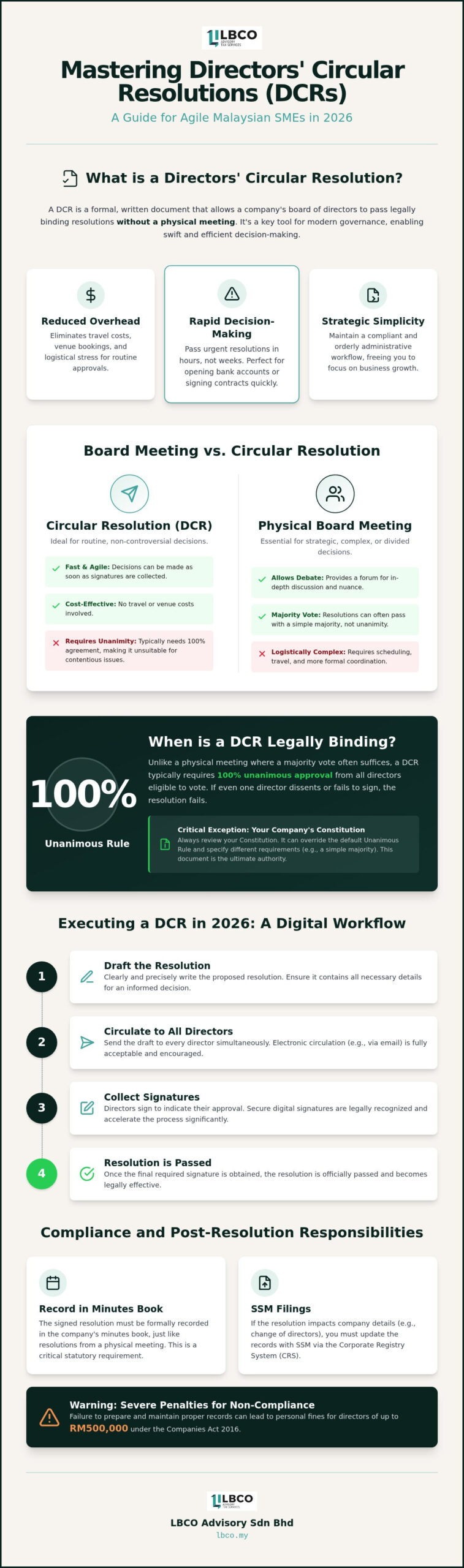
One of the most frequent points of confusion for SME owners is the “Unanimous Rule.” In a physical board meeting, a simple majority is often enough to pass a motion. However, a circular resolution typically requires 100% approval from all eligible directors. This higher threshold exists because the traditional opportunity for debate and discussion is absent. If even one director dissents or refuses to sign, the circular resolution usually fails. You should always check your company’s Constitution first. Some modern Constitutions are drafted to allow for majority consent on specific matters, but without such a clause, the default expectation is total agreement. If you find yourself facing a split board, it’s often safer and more transparent to convene a formal meeting instead.
Circulation and Documentation Standards
Legally, you can’t just hand a document to the directors who happen to be in the office. You must circulate the resolution to every single eligible director at their last known address or registered email. This ensures that everyone is fully informed of the proposed decision. The language used in the text must be clear, unambiguous, and leave no room for misinterpretation. To maintain a high standard of compliance, many proactive business owners rely on professional Company Secretarial Services to oversee the drafting and circulation process, ensuring that no technicalities are missed.
When it comes to timeframes, the law expects directors to sign within a “reasonable time.” While the Act doesn’t define this as a specific number of days, it’s generally dictated by the urgency of the matter and any deadlines set within the resolution itself. Failing to meet these Companies Act 2016 requirements can lead to the resolution being deemed ineffective. To avoid common pitfalls, keep a close eye on these recurring issues that often trigger SSM red flags:
- Incomplete signatures: Missing even one signature from an eligible director without a valid constitutional exemption.
- Poor record-keeping: Failing to keep the original signed copies or digital audit trails.
- Vague wording: Drafting resolutions that don’t clearly state the specific action being authorized.
- Skipping the Secretary: Not involving your company secretary to formally record the resolution in the minutes book.
By treating these administrative steps as strategic advantages rather than mere chores, you protect your company’s health and your own professional standing.
Board Meeting vs. Circular Resolution: Which to Choose?
Choosing between a formal meeting and a directors circular resolution malaysia often comes down to the nature of the decision. While DCRs offer unmatched speed, they shouldn’t replace every board interaction. If the matter is routine, like opening a bank account or appointing an auditor, a circular resolution is your best friend. It keeps your business moving without the logistical drag of a meeting. However, if the decision involves complex strategic shifts or contentious internal issues, a meeting is usually the wiser choice. The “debate factor” is the most reliable guide here. Does this decision require real-time discussion to reach a sound conclusion? If the answer is yes, gathering the board is essential.
Ideal Scenarios for Circular Resolutions
DCRs excel when the board is already in agreement and simply needs to formalize a decision for statutory purposes. They are perfect for routine administrative updates, such as changing your registered office address or updating bank signatories. You’ll also find them highly effective for approving standard accounting and tax filings. When everyone is on the same page, a circular resolution removes the friction of physical attendance, allowing you to focus on growth. It’s a streamlined way to handle the “business as usual” tasks that keep your company compliant without draining your time.
When a Physical (or Virtual) Meeting is Mandatory
Certain situations demand the transparency and formal minute-taking that only a meeting can provide. For instance, the Companies Act 2016 requires specific procedures for removing a director or an auditor before their term expires. These are sensitive matters where the right to be heard is paramount. Significant capital restructuring, mergers, or acquisitions also benefit from a meeting environment. In these high-stakes scenarios, the ability to record dissenting views and detailed deliberations protects the board’s integrity. Since a directors circular resolution malaysia usually requires unanimous consent, a meeting is the only practical way to pass a resolution when directors hold differing opinions. It ensures that every voice is heard and every concern is documented, providing a level of protection that a simple signature cannot offer.
Executing a DCR in 2026: Digital Signatures and Process
Executing a directors circular resolution malaysia has evolved from a paper-heavy chore into a swift, digital-first operation. With the launch of the SSM Corporate Registry System (CRS) on July 14, 2026, the transition toward a paperless government ecosystem is now the standard for Malaysian SMEs. This modern workflow eliminates the friction of physical couriers and wet-ink signatures, allowing you to finalize board decisions in minutes rather than days. It’s about replacing administrative hurdles with a system that respects your time and your company’s need for agility.
To ensure your resolution is legally sound and audit-ready, follow this streamlined five-step process:
- Step 1: Drafting. Your Company Secretary prepares the resolution text to ensure it meets statutory requirements and aligns with your company’s Constitution.
- Step 2: Circulation. The document is sent via secure electronic channels to every eligible director’s registered email or digital portal.
- Step 3: Verification and Signing. Directors verify their identities and apply their digital signatures through encrypted, legally compliant platforms.
- Step 4: Centralization. Once signed, the documents are automatically returned to the secretarial record, creating a clear and permanent audit trail.
- Step 5: Formal Entry. The resolution is entered into the company’s Minutes Book, ensuring you satisfy the mandatory record-keeping duties under the Companies Act 2016.
The Legality of Digital Signatures in Malaysia
The legal foundation for this digital shift rests on the Digital Signature Act 1997 and the Electronic Commerce Act 2006. In 2026, SSM fully recognizes digitally signed DCRs, provided they use secure and verifiable technology. While basic electronic signatures are recognized, using licensed Certification Authority platforms like DocuSign or specialized secretarial portals offers a higher level of security. This protects your board from identity fraud and ensures that your statutory filings remain beyond reproach. It’s a proactive way to safeguard your company’s governance while embracing modern efficiency.
The Role of the Company Secretary in Execution
Your Company Secretary acts as the essential coordinator of this entire digital workflow. They ensure the resolution is dated correctly, avoiding compliance gaps that could lead to significant fines. At LBCO, we use cloud technology to streamline this for Ipoh entrepreneurs and business owners across Malaysia. This approach means you spend less time on mundane paperwork and more time on the strategic growth of your venture. If you want to experience a truly frictionless governance process, partner with our expert company secretarial team today for a more secure, modern future.
Compliance and Post-Resolution Responsibilities
Passing the document is only the beginning of your compliance journey. Updating the company’s Minutes Book is a non-negotiable statutory requirement once a directors circular resolution malaysia has been signed and returned. This isn’t just a best practice; it’s a legal mandate under the Companies Act 2016 that ensures your company’s history is transparent and verifiable. These records must be kept at your Registered Office, where they remain accessible for inspection by directors and auditors at any time. For SMEs across Northern Malaysia, the transition to digital minutes is gaining momentum, offering a more secure alternative to traditional physical binders. This shift ensures that your governance records are protected from physical damage and are always ready for an unexpected audit.
Certain resolutions trigger a mandatory filing with the SSM, such as changes to director particulars or the allotment of new shares. In the current 2026 enforcement climate, the stakes for passing a directors circular resolution malaysia without proper follow-up are incredibly high. Failing to lodge required documents can result in personal fines for directors of up to RM500,000 for financial statement failures or RM50,000 for Annual Return delays. There is even a daily penalty of RM1,000 for continuing offences after a conviction. While DCRs manage board-level agility, they must remain distinct from member-level decisions typically reserved for the Annual General Meeting (AGM). Keeping these boundaries clear prevents confusion and maintains your professional standing.
Maintaining the Minutes Book and Statutory Records
Statutory records serve as the definitive evidence of your company’s decisions and corporate health. Directors and auditors have a legal right to inspect these books, making it essential to keep them updated in real-time. If you operate in Ipoh or the surrounding Perak region, moving toward a cloud-integrated minutes system can simplify this process significantly. It allows for immediate entry of resolutions and ensures that your company secretary can verify the documentation without the delays of physical mail. This proactive approach to record-keeping is what separates a thriving, audit-ready SME from one that struggles with regulatory friction.
LBCO Advisory: Your Partner in Seamless Compliance
Managing these statutory timelines often feels like a heavy administrative burden. Our company secretarial retainer is designed to remove the stress of DCR management entirely, giving you back the time to focus on your business growth. We provide proactive alerts for upcoming compliance deadlines specifically for business owners in Ipoh, Kampar, and Taiping. By integrating your board resolutions with cloud bookkeeping, we offer a holistic view of your business health. We turn mundane chores into strategic advantages, ensuring your company remains a beacon of reliability and precision in a competitive market.
Secure Your Board’s Future with Modern Governance
Mastering the directors circular resolution malaysia process is about more than just avoiding fines; it’s about building a company that’s ready for the speed of 2026. You’ve seen how digital signatures and clear circulation paths can transform your board’s decision-making from a logistical hurdle into a strategic advantage. By prioritizing proper record-keeping in your minutes book and staying ahead of SSM’s evolving digital standards, you protect your company’s integrity and your own peace of mind.
You don’t have to manage these complex statutory burdens alone. Since 1987, LBCO Advisory has been the trusted partner for SMEs in Ipoh and Northern Malaysia, providing proactive management of all your SSM requirements. Our cloud-integrated compliance solutions are designed for the modern entrepreneur who values precision and ease. Simplify your company compliance with LBCO’s expert secretarial services today. We’re here to clear the path so you can focus on what you love most: growing your business. Your success is our mission, and we’re excited to help you navigate your next chapter with confidence.
Frequently Asked Questions
Can a Director’s Circular Resolution be passed by a majority of directors?
A directors circular resolution malaysia typically requires unanimous consent from all eligible directors to be legally binding. While a physical board meeting often relies on a simple majority, the lack of real-time debate in a circular format demands total agreement. You should always review your company’s Constitution, as it can be customized to allow for majority approval on specific routine matters. This is a common point of confusion for many new SMEs in Ipoh.
Is an email approval considered a valid signature for a DCR in Malaysia?
Simply replying “approved” in an email thread isn’t sufficient to meet the legal standards for a signature in Malaysia. Under the Electronic Commerce Act 2006 and the Digital Signature Act 1997, you must use a verifiable electronic or digital signature. Modern entrepreneurs in Perak often use cloud-based platforms like DocuSign to ensure their approvals are secure, tamper-proof, and fully recognized by the Companies Commission of Malaysia (SSM) during any future audits.
How long must a company keep copies of its circular resolutions?
Your company must maintain copies of all board resolutions for at least seven years from the date they were passed. These records should be kept at the registered office, which for many of our clients is our professional office in Ipoh. Maintaining these statutory records is a non-negotiable duty under the Companies Act 2016. Failing to produce these documents during an SSM inspection can lead to significant compounds and administrative delays for your business.
Can a DCR be used to remove a director from the board?
No, you cannot use a circular resolution to remove a director from the board before their term expires. Section 206 of the Companies Act 2016 mandates a physical or virtual General Meeting where the director in question has the right to be heard. This protection ensures transparency and fairness for all parties involved. If your board in Taiping or Kampar is facing such a sensitive transition, it’s vital to follow the formal meeting procedures to avoid potential legal challenges.
What is the difference between an Ordinary Resolution and a Director’s Resolution?
The primary difference lies in who is making the decision. An Ordinary Resolution is a decision made by the shareholders, usually requiring more than 50% approval at a general meeting. A Director’s Resolution is a decision made by the board of directors to manage the company’s daily operations. While shareholders focus on high-level matters like appointing auditors, directors handle tasks such as entering contracts or opening bank accounts for their Perak-based business ventures.
Do I need to file every circular resolution with SSM?
You don’t need to file every directors circular resolution malaysia with the SSM. Most board decisions are internal administrative matters that stay in your company’s Minutes Book. However, resolutions that trigger statutory changes, such as changing your registered office address in Gopeng or allotting new shares, must be lodged through the SSM Corporate Registry System (CRS). Your company secretary will identify which specific resolutions require these mandatory filings to maintain your official compliance status.
Can a sole director company use circular resolutions?
Yes, a sole director company can and should use circular resolutions to document official board decisions. Even if you’re the only director of your Sdn Bhd in the Cameron Highlands, you must still record your decisions in writing to satisfy statutory requirements. These resolutions serve as the formal evidence of your company’s actions. This is essential for opening bank accounts, applying for licenses, or satisfying the queries of future auditors and tax authorities as your company grows.
What happens if a director refuses to sign a circular resolution?
If a director refuses to sign a circular resolution, the resolution typically fails to pass because most DCRs require unanimous consent. This refusal effectively acts as a veto. In such cases, the best solution is to convene a formal board meeting, either physically in Ipoh or virtually. A meeting allows for a formal vote where a simple majority might be enough to pass the motion, depending on the specific rules laid out in your company’s Constitution.