


Could a single missing line on a digital statement really trigger a RM10,000 fine for your business? Managing a growing team in Malaysia is rewarding, but the weight of payroll compliance often feels like a moving target. We understand the stress of wondering if your manual spreadsheets have kept up with the 2026 minimum wage hike or the mandatory EPF changes for foreign workers. It’s exhausting to spend hours on calculations when you should be focusing on your next big growth milestone.
You deserve a process that’s effortless and accurate. By mastering the 2026 malaysia payslip requirements, you’ll transform payroll from a monthly headache into a strategic advantage that protects your company and honors your employees. We’re here to help you move from confusion to total confidence with a clear, professional roadmap. This guide provides a definitive checklist of mandatory payslip items, explains the latest statutory deduction rates, and offers a streamlined approach to help you stay ahead of the curve while freeing up your valuable time.
Key Takeaways
- Understand the legal foundation under Section 60L of the Employment Act 1955 to ensure your business remains fully compliant with current labor laws.
- Identify the specific mandatory components of malaysia payslip requirements for 2026, including detailed breakdowns of gross salary and statutory contributions.
- Discover why transitioning to secure digital e-payslips is the modern standard for improving employee accessibility and streamlining administrative records.
- Implement a consistent payroll cycle and master the “7th of the month” rule to maintain timely salary processing and avoid legal pitfalls.
- Learn how professional payroll management can act as a path-clearer, allowing you to focus on business growth while experts handle complex calculations.
Understanding Mandatory Payslips Under the Employment Act 1955
A payslip is more than just a piece of paper; it’s a mandatory legal document that provides a transparent breakdown of an employee’s earnings and deductions for a specific wage period. Under Section 60L of the Employment Act 1955, Malaysian employers are legally required to provide these written statements to maintain clarity. This transparency is vital within the broader Malaysian economic context, where fair labor practices support a thriving and stable workforce. Understanding the specifics of malaysia payslip requirements helps you build a more resilient organization.
A compliant payslip serves as a transparent record of the employer-employee contract, ensuring both parties are aligned on the value of work performed.
Compliance isn’t just about ticking a box. It’s your first line of defense against LHDN audits and Labor Court disputes. When every ringgit is accounted for, you eliminate the ambiguity that often leads to costly legal friction.
Legal Obligations for Malaysian Employers
Staying compliant means adhering to specific timelines. You must issue payslips to every employee on or before their actual payday. This rule applies universally; whether you’ve hired a full-time manager or a part-time student, they all require a formal statement.
Record-keeping is equally critical. You’re required to maintain these payroll records for a minimum of seven years. This long-term diligence ensures you’re always audit-ready, providing a clear trail of statutory contributions like EPF and SOCSO. It’s a simple habit that prevents massive headaches down the road.
Penalties for Non-Compliance in 2026
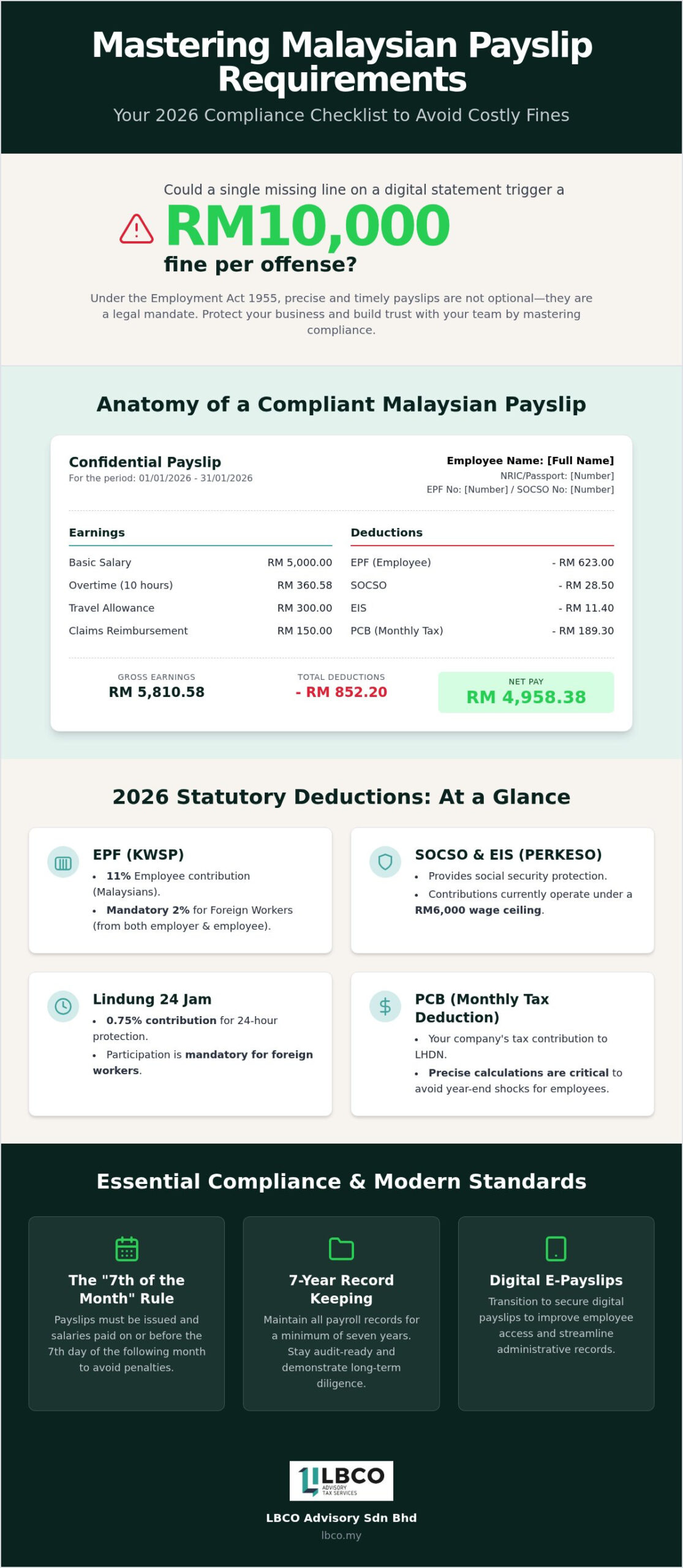
The cost of cutting corners is steep. Failing to provide a proper wage statement can result in fines of up to RM10,000 per offense. Beyond direct penalties, poor payroll documentation complicates your corporate tax planning and can trigger red flags during audits.
Maintaining precise records allows you to claim tax deductions accurately while demonstrating your integrity as a business owner. Just as you must avoid SSM penalties through diligent corporate secretarial work, keeping your payroll in order is essential for long-term survival. Meeting malaysia payslip requirements isn’t just a hurdle; it’s a strategic move that builds trust with your team and protects your bottom line.
Mandatory Components of a Malaysian Payslip
Meeting malaysia payslip requirements involves more than just listing a final net pay amount. A professional statement provides a granular view of an employee’s journey throughout the month. It starts with identifying data: the employee’s full name, NRIC or passport number, and their unique EPF and SOCSO membership numbers. Without these identifiers, the document lacks the legal weight needed for official audits or bank loan applications.
You must also clearly itemize the gross salary components. This includes the basic wage, any overtime hours worked, and specific allowances. It’s vital to separate these figures so employees understand exactly how their effort translates into earnings. Providing this level of detail builds a culture of transparency and respect within your team.
Statutory Deductions: EPF, SOCSO, EIS, and PCB
The core of Malaysian payroll compliance lies in these four pillars. For 2026, you must ensure EPF (KWSP) contributions are calculated accurately. While most local employees see an 11% deduction, keep in mind that foreign workers now require a mandatory 2% contribution from both the employer and the employee. SOCSO (PERKESO) and EIS contributions now operate under a RM6,000 wage ceiling, providing essential social security for your workforce.
Additionally, the Lindung 24 Jam scheme remains a critical update. It introduces a 0.75% contribution for participating local employees and mandatory participation for foreign workers, offering around-the-clock protection. Finally, PCB (Monthly Tax Deduction) must be precise. Incorrect tax calculations often lead to stressful year-end shocks for your team, which can damage morale and trust in your administration. Mastery of these malaysia payslip requirements ensures your business remains a reliable guardian of employee welfare.
Allowances and Claims Management
Handling allowances requires a keen eye for detail. You need to distinguish between taxable fixed allowances, like housing or car perks, and non-taxable reimbursements for business expenses. Documenting claims as separate line items ensures you don’t accidentally inflate an employee’s taxable gross income, which could lead to overpayment of PCB.
For eligible SME employers, the HRDF levy must also be accounted for to support national talent development. Managing these moving parts doesn’t have to be a burden that keeps you up at night. If you’re looking to simplify your month-end and remove administrative friction, exploring professional payroll management can provide the clarity you need to stay focused on your primary business goals.
Digital vs. Physical Payslips: The 2026 SME Standard
The era of the carbon-copy payslip is quickly fading into the past. In 2026, forward-thinking SMEs are embracing secure e-payslips to stay organized and fully compliant. Digital statements don’t just save paper; they provide your team with instant, mobile-friendly access to their entire financial history. This shift is a key part of modernizing your approach to malaysia payslip requirements, moving from dusty filing cabinets to a streamlined, accessible digital archive.
Manual calculations are often the root cause of stressful payroll disputes. By automating your process, you eliminate the risk of human error in complex formulas. This transition is naturally paired with broader digital transformations, such as adopting Cloud Bookkeeping Services Malaysia, ensuring your financial records are always synchronized and audit-ready.
The Benefits of Cloud-Based Payroll Integration
Cloud systems act as a proactive partner for your business growth. They offer a sense of relief by handling the heavy lifting of administrative tasks. Consider these advantages:
- Gain real-time visibility into payroll expenses to sharpen your cash flow management.
- Ensure seamless synchronization with your monthly accounting and bookkeeping retainers.
- Enjoy automatic updates for the latest 2026 statutory rates, including the RM6,000 SOCSO ceiling and the new Lindung 24 Jam contributions.
This integration ensures your payroll isn’t a siloed task but a strategic part of your overall business health. It allows you to focus on your primary passions while the technology handles the precision.
Data Security and Employee Privacy
Handling sensitive information requires the mindset of a reliable guardian. Under the Personal Data Protection Act (PDPA), you have a legal and moral duty to protect your team’s personal data. Sending unsecured email attachments is no longer an acceptable standard for professional organizations. It’s time to move toward more secure, encrypted alternatives.
Switching to encrypted delivery methods or secure payroll portals builds immense trust with your workforce. When your team knows their NRIC numbers and bank details are safe, it fosters a deep sense of peace of mind. Transparent portals allow employees to view their own records without administrative friction, removing hurdles for both you and your staff. Adhering to these modern malaysia payslip requirements shows your commitment to innovation and employee welfare.
Payroll Best Practices for SME Employers in Malaysia
Establishing a predictable rhythm for your payroll isn’t just about financial administration; it’s about building a foundation of trust with your team. A consistent payroll cycle ensures that every calculation, from basic wages to complex overtime, is processed with precision. When your employees know exactly when to expect their salary, it fosters a sense of security that allows them to focus entirely on their roles. Mastering these malaysia payslip requirements transforms a monthly chore into a strategic advantage for your business culture.
The “7th of the month” rule is a critical boundary every Malaysian employer must respect. Under the Employment Act, you’re legally obligated to pay your employees no later than the seventh day after the end of the wage period. While competitors often focus on the penalties of late payment, we view this deadline as an opportunity to demonstrate your reliability. Setting an internal processing date a few days earlier acts as a safety net, ensuring you’re never rushing to meet the legal cutoff during public holidays or bank delays.
Proactive tax planning starts with accurate Monthly Tax Deduction (PCB) reporting. By ensuring that every employee’s tax relief status is updated in real-time, you prevent the stress of significant year-end adjustments. Integrating your leave and attendance data directly into your payroll workflow further reduces friction, ensuring that unpaid leave or overtime claims are reflected accurately without manual data entry errors.
Record-Keeping and Audit Readiness
Maintaining a “clean” audit trail is the hallmark of a professional SME. You’re required to keep all payroll records for a minimum of seven years, ensuring you’re always ready for a surprise visit from LHDN or EPF officers. Organizing these files digitally makes retrieval effortless; you won’t have to spend hours digging through physical folders. This level of organization is a natural extension of robust SME Financial Reporting Malaysia, which provides the transparency needed for long-term growth and investor confidence. Don’t forget that issuing accurate EA Forms by the end of February is a vital service to your employees, helping them navigate their personal tax season with ease.
Common Payroll Mistakes to Avoid
Even seasoned business owners can stumble on technicalities. One frequent error involves the incorrect calculation of overtime rates, especially during public holidays where the multiplier increases. With the national minimum wage now at RM1,700, ensuring your base calculations are correct is more important than ever. Other common pitfalls include:
- Failing to update an employee’s marital or parental status, which directly impacts their PCB tax relief eligibility.
- Misclassifying long-term contractors as employees, or vice versa, which can lead to massive back-dated claims for EPF and SOCSO contributions.
- Ignoring the RM6,000 wage ceiling for SOCSO and EIS, leading to over-contribution and messy refund applications.
Navigating these complexities doesn’t have to be your burden alone. If you’re ready to remove the hurdles of manual administration and ensure your business remains 100% compliant, our team is here to help. Discover how our payroll management services can streamline your operations and give you the peace of mind you deserve.
Streamlining Your Compliance with LBCO Payroll Management
Managing the intricate details of malaysia payslip requirements doesn’t have to be a lonely or overwhelming task. At LBCO Advisory, we act as your dedicated “Path-Clearer,” removing the administrative hurdles that often slow down ambitious business owners. Whether you’re operating an established firm in Ipoh or a growing startup in Kampar, our team provides the localized expertise needed to navigate the Malaysian regulatory landscape with ease. We believe that your time is best spent on your primary passions, not on manual data entry or deciphering complex tax codes. Our presence across Northern Malaysia ensures that help is always accessible and tailored to your specific regional needs.
Our approach combines the reliability of an established firm, rooted since 1987, with the innovation of modern cloud technology. This ensures that your salary processing is not just error-free but also highly efficient. You gain the peace of mind that comes from knowing every EPF contribution and SOCSO deduction is handled by experts who treat your compliance as their own. As your “Reliable Guardian,” we meticulously monitor every change in labor law so you don’t have to.
Why Outsource Your Payroll to Experts?
Outsourcing your payroll allows your internal team to step away from mundane chores and pivot toward strategic growth. By leveraging our professional payroll management, you access advanced cloud-based systems without the heavy overhead of purchasing and maintaining your own software. This setup provides real-time financial visibility while ensuring you’re always aligned with the latest legal standards. As labor laws and tax requirements evolve throughout 2026, having a proactive partner ensures you never fall behind or face the stress of accidental non-compliance. We handle the complexity so you can enjoy the simplicity of a well-oiled business machine.
Your Strategic Partner for Business Success
We view ourselves as more than just a service provider; we’re your strategic partner in every stage of your business journey. From the initial stages of Sdn Bhd incorporation to complex corporate tax planning, we provide a holistic support system that grows with you. A simplified back-office is the catalyst for successful market entry and sustained expansion. We celebrate your milestones as if they were our own, providing the steady hands needed to manage your financial health and employee satisfaction. Our goal is to move beyond mere data entry, offering proactive financial and tax planning that prepares you for the future.
Ready to experience a seamless transition to professional payroll? Contact LBCO Advisory today to discover how we can help you master malaysia payslip requirements while you focus on building your legacy. Our experts are standing by to offer the reassuring support and professional authority your business deserves.
Empowering Your Business with Compliant Payroll
Mastering the latest malaysia payslip requirements is more than a legal necessity; it’s a commitment to your team’s welfare and your company’s long-term stability. By transitioning to secure digital systems and adhering to the 2026 statutory standards, you replace monthly administrative stress with a streamlined, audit-ready workflow. You’ve seen how precise record-keeping and timely salary processing protect your bottom line from costly penalties while fostering deep trust with your employees.
Now is the time to move beyond manual spreadsheets and embrace a future of efficiency. Our team is dedicated to acting as your strategic partner, offering expert payroll management for Malaysian SMEs with the local support you need in Ipoh and across Northern Malaysia. We provide cloud-integrated compliance for complete peace of mind, allowing you to focus on the business growth you’re passionate about. We handle the complexity so you can enjoy the simplicity.
Simplify your payroll compliance today with LBCO Advisory and experience the relief of having a reliable guardian for your administrative needs. We’re excited to support your journey toward a more professional and effortless future.
Frequently Asked Questions
Is it mandatory to provide a payslip in Malaysia for 2026?
Yes, it’s a legal mandate. Section 25A of the Employment Act 1955 requires every employer to provide a detailed statement for each wage period. This applies to all businesses, including SMEs in Ipoh and Kampar. Failing to comply is a breach of the law and can lead to significant fines. Providing these documents ensures your team feels valued and your business stays clear of legal hurdles.
What is the latest date an employer can pay salary in Malaysia?
Salaries must be paid no later than the 7th day after the end of the wage period. If the 7th falls on a weekend or public holiday, it’s best practice to pay earlier. Staying ahead of this deadline ensures your team stays motivated and your business remains in good standing with labor authorities. It’s a simple way to demonstrate your reliability as a strategic partner to your employees.
What are the compulsory deductions for a Malaysian payslip?
Standard malaysia payslip requirements include deductions for EPF (KWSP), SOCSO (PERKESO), and the Employment Insurance System (EIS). You must also calculate the Monthly Tax Deduction (PCB) accurately to avoid year-end tax shocks. For 2026, ensure you include the Lindung 24 Jam contribution for participating employees and mandatory EPF for foreign workers. These contributions are the backbone of a compliant and supportive payroll process.
Can an employer issue payslips in digital format only?
Yes, you can issue payslips in a purely digital format. E-payslips are legally recognized in Malaysia and offer a more secure, streamlined way to distribute information. Using cloud-based portals allows your staff in locations like Gopeng or Taiping to access their records instantly on their mobile devices. This modern approach protects sensitive data and removes the friction of physical paperwork for your administrative team.
How long must an employer keep payroll records in Malaysia?
Employers must maintain all payroll and wage records for at least seven years. This long-term storage is vital for audit readiness during LHDN or EPF inspections. Keeping these documents organized digitally ensures you can retrieve them effortlessly, providing a clear trail of compliance that protects your business’s financial health. It’s a proactive habit that gives you total confidence when facing regulatory reviews or internal financial assessments.
What happens if an employer fails to provide a payslip?
Failing to provide a proper payslip can result in a maximum fine of RM10,000 per offense. Beyond the financial penalty, it can lead to Labor Court disputes and damage your reputation as a reliable employer. Consistent compliance with malaysia payslip requirements is the best way to ensure peace of mind and avoid these unnecessary hurdles. We help you stay ahead of these risks with professional, error-free processing.
Are part-time employees entitled to a payslip in Malaysia?
Yes, part-time employees are absolutely entitled to receive a payslip. The Employment Act doesn’t differentiate between full-time and part-time staff when it comes to wage statements. Every worker who performs labor for your company deserves a transparent breakdown of their earnings and statutory contributions. This transparency builds a culture of respect and ensures that every member of your team feels secure in their employment.
Do I need to include HRDF contributions on the employee’s payslip?
You don’t typically need to show HRDF contributions on an employee’s payslip because it’s a levy paid by the employer, not a deduction from the worker’s salary. However, maintaining internal records of these payments is essential for your annual financial reporting and compliance. It’s another layer of administrative detail that we help SMEs in Perak manage, ensuring your back-office remains streamlined and fully organized.